Why Ordering Custom Coffee Bags Trips Up Good Roasters
A custom coffee bag order should be one of the most satisfying parts of building a brand. You finally get to put your name on packaging that looks the way you always pictured it. Yet this is also where a lot of roasters lose money, lose time, and end up with a garage full of bags they cannot use. The strange thing is that it almost never comes down to taste or design. It comes down to small technical decisions that get rushed at the start.
The reason these mistakes hurt so much is that they stay hidden until it is too late to fix them cheaply. A wrong number on an order form does not look like a problem. It looks like a finished spec, right up until a pallet of bags arrives and the beans do not fit, or the valve sits in the wrong spot, or the coffee goes stale weeks before it should. By then the money is already spent. Knowing where these traps sit is the difference between a smooth reorder and a painful do-over.
Most of the trouble falls into a handful of repeat offenders. Each one is easy to sidestep once you see it coming, and none of them require you to be a packaging engineer. They just require you to slow down at the right moments and ask the right questions before the order goes to print.
Mistake One: Guessing the Bag Size Instead of Matching It to the Coffee
The most common mistake is also the most basic. Roasters pick a bag by the weight printed on a competitor's bag, assume a twelve ounce bag is a twelve ounce bag, and order. The problem is that coffee is not measured by volume, and beans take up wildly different amounts of space depending on the roast. A light roast is dense and packs tight, while a dark roast is puffed up and takes far more room for the same weight. A bag that fits one can look half empty or overstuffed with the other.
Bag size is about the space your beans actually occupy, not just the number on the label. The right move is to weigh your real product and see how it sits in a sample bag before you commit to a size for the whole run. Whole bean and ground coffee behave differently too, since ground coffee settles and fills space in its own way. A few minutes with a scale up front saves you from a bag that never looks right on the shelf.
- Match the bag to your actual roast, since light and dark roasts fill space very differently
- Test whole bean and ground separately, because they settle and pack at different rates
- Leave room for a proper seal at the top, not just enough space to cram the coffee in
- Picture the bag full and standing, not flat and empty, when you judge whether the size works
Mistake Two: Skipping the Physical Proof
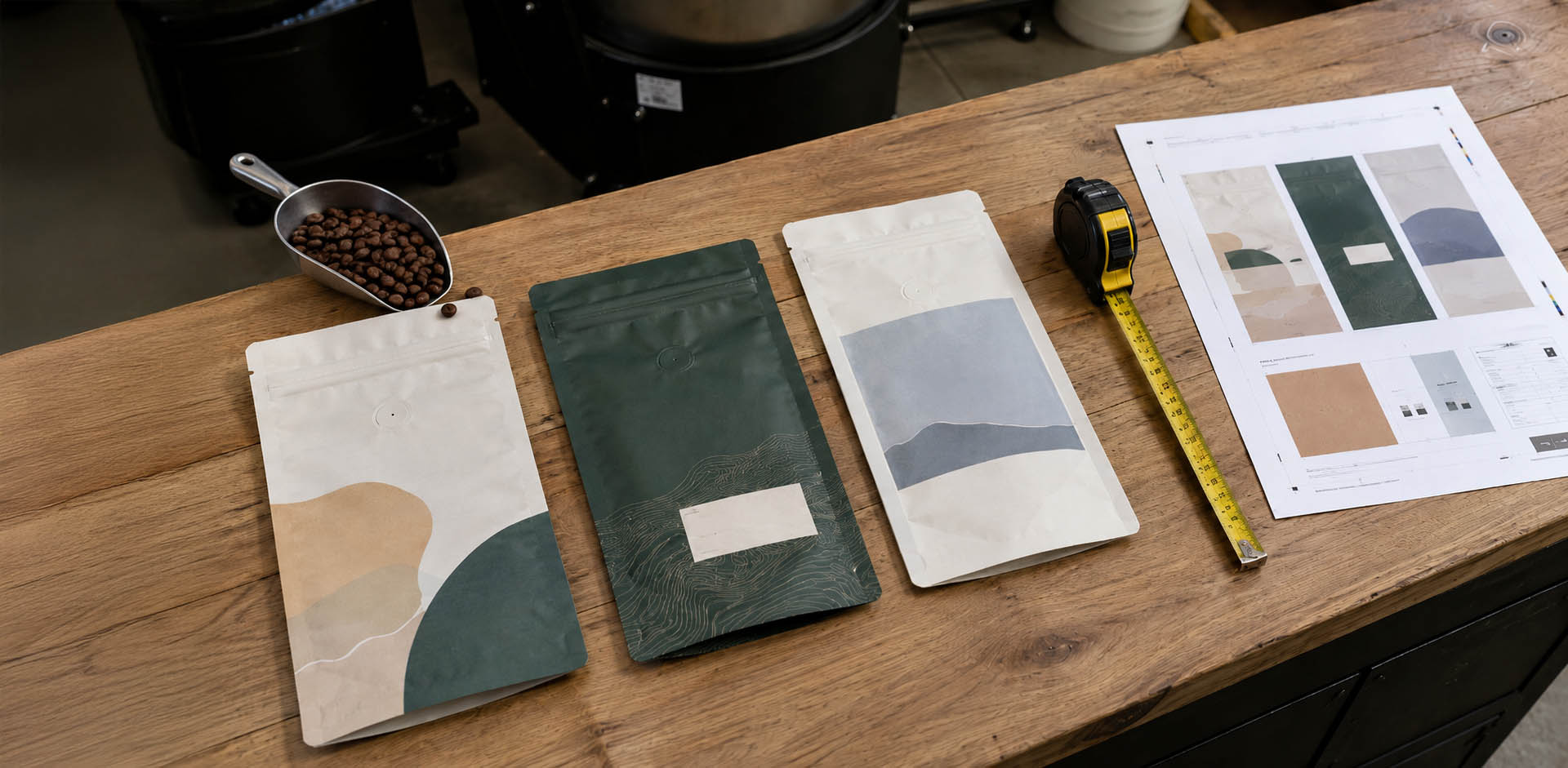
A screen lies. Colors glow on a monitor in a way they never will on a matte film, and what looks like a rich deep brown on your laptop can land as a flat muddy tone on a real bag. Roasters who approve artwork from a screen alone are gambling with the single most visible part of their brand. The fix is cheap and almost foolproof, which is to ask for a physical proof before the full run prints.
A physical proof lets you hold the actual bag, in the actual material, with the actual print, and check it under the lights where it will really live. You catch color shifts, you see how a finish changes the look, and you find typos that somehow slipped past everyone on screen. Spending a little time here protects the entire order. It is far better to reject a proof and adjust than to unwrap a thousand bags and discover the logo color is wrong. When you order
custom coffee bags, treat the proof as a required step, not an optional one.
Mistake Three: Underestimating Lead Times
Custom packaging runs on a calendar that is longer than most first-time buyers expect. Roasters often think in terms of a few days, the way they would for an online order, when custom bags involve artwork approval, proofing, printing, finishing, and shipping. Each step takes real time, and they happen in order, not all at once. The roaster who waits until the current bags run low to place a reorder is the roaster who ends up bagging coffee in plain pouches during a busy season.
The mistake is treating packaging like a last-minute supply instead of a planned one. Lead times stretch even longer around holidays and seasonal pushes, exactly when you can least afford to be out of bags. The smart habit is to reorder well before you hit your last box, and to ask for the real timeline up front so you can plan around it. A little forward planning turns packaging from a fire drill into a routine.
- Ask for the full timeline before you order, including proofing and shipping, not just print time
- Reorder while you still have several weeks of bags left, never when you are nearly out
- Add extra buffer before holidays and seasonal launches, when demand and lead times both rise
- Keep your artwork files organized and ready, so approvals never become the slow step
Mistake Four: Putting the Valve in the Wrong Place
Fresh roasted coffee gives off carbon dioxide for days, so nearly every coffee bag needs a one-way degassing valve to let that gas escape without letting oxygen in. That part most roasters know. What trips them up is where the valve goes. Place it too low and your coffee buries it, place it too high and it interferes with the seal, and place it where your design needs to be clean and it fights with your artwork. The valve is a small part with an outsized ability to ruin a nice bag.
Valve placement has to be planned alongside the artwork and the fill level, not bolted on at the end. The valve needs to sit in the headspace above the coffee so it can actually vent, which means you have to know your fill level before you lock the valve position. It also needs to land somewhere your design can live with, so the logo and the valve are not crowding each other. Thinking about the valve early keeps it from becoming an ugly surprise on an otherwise beautiful bag.
Mistake Five: Mismatching the Barrier Film to the Product
Not every bag protects coffee equally, and ordering the wrong film is a mistake you do not notice until your coffee tastes flat. The barrier is the part of the bag that keeps oxygen and moisture out, and coffee is unusually sensitive to both. A thin, cheap film might be fine for a product that sells in days, but coffee that sits on a shelf for weeks needs a real barrier or the oils go stale and the aroma fades. Choosing a film on price alone is how roasters end up with bags that look great and protect poorly.
The barrier has to match how your coffee is sold and how long it needs to last. Coffee headed for distribution and weeks on a store shelf needs more protection than coffee sold the same week at a farmers market. This is also where your print method enters the picture, since the right choice depends partly on your order size. Smaller, flexible runs often suit
digital packaging, while very large volume orders are where
rotogravure printing earns its keep. Matching the film and the method to your real shelf life and volume is what keeps the coffee as fresh as the day it was roasted.
Mistake Six: Ordering the Wrong Quantity for Your Stage
The last common mistake pulls in two directions. Some roasters order far too few bags, paying a high price per bag and running out fast, while others get talked into a giant run to chase a low unit price and end up sitting on years of inventory with outdated artwork. Both hurt, just in different ways. The right quantity is the one that matches where your brand actually is, not where you hope it will be.
The honest question is how fast you really move coffee and how settled your design is. A brand still tweaking its look should not lock thousands of dollars into bags it may want to change. A steady seller with a proven design can lean into a larger run and save real money per bag. Run size also ties back to print method, since digital suits smaller, flexible orders and large rotogravure runs reward high volume. Being honest about your stage keeps your cash where it belongs, in coffee and growth, instead of frozen in a wall of boxes.
- Match your run size to how quickly you actually sell, not to the lowest possible unit price
- Avoid huge runs while your branding is still changing, since outdated bags are wasted money
- Use smaller, flexible runs to test new products or seasonal designs before you scale up
- Remember that a low price per bag is no bargain if half the bags never get used
How to Order Custom Coffee Bags the Right Way
None of these mistakes require special expertise to avoid. They just require asking a few good questions before the order goes to print, instead of after the bags arrive. The roasters who get clean, repeatable orders are the ones who treat the setup phase as the important part and let the printing take care of itself. A short conversation up front prevents nearly every expensive surprise on the back end.
The simplest way to protect an order is to bring all of these decisions to your packaging partner at the very start, while everything can still change easily. A good partner will help you size the bag to your roast, send you a real proof, lay out an honest timeline, place the valve correctly, match the barrier to your shelf life, and recommend a run size that fits your stage. Here is the short checklist worth keeping next to you the next time you place an order.
- Size the bag to your actual roasted coffee, tested with a scale, not to a number on a competitor's label
- Always approve a physical proof before the full run, never just a screen version
- Get the full lead time in writing and reorder well before you run low
- Plan valve placement around your fill level and your artwork together
- Match the barrier film and print method to your shelf life and order size
- Choose a quantity that fits how fast you sell and how settled your design is
Closing: Order Once, Order Right
The Bags That Show Up Exactly As You Pictured Them
Ordering custom coffee bags does not have to be a guessing game, and the roasters who get burned are almost never the ones who lacked good taste. They are the ones who rushed a technical decision that quietly shaped the whole order. Size, proofing, lead time, valve placement, barrier film, and quantity are the six places where good orders go wrong, and every one of them is simple to handle once you know to look for it. Slow down at the start, ask the questions while the answers are still cheap to change, and lean on a partner who has seen these traps a thousand times. Do that, and your bags show up looking exactly the way you imagined, fitting your coffee, protecting your roast, and ready for the shelf the day they land.