The V Is the Bottom, Not the Top
Almost everyone gets this wrong the first time, including people who have been buying coffee bags for years. The name sounds like it describes an angled opening at the top of the bag. It does not. The V cut is the bottom.
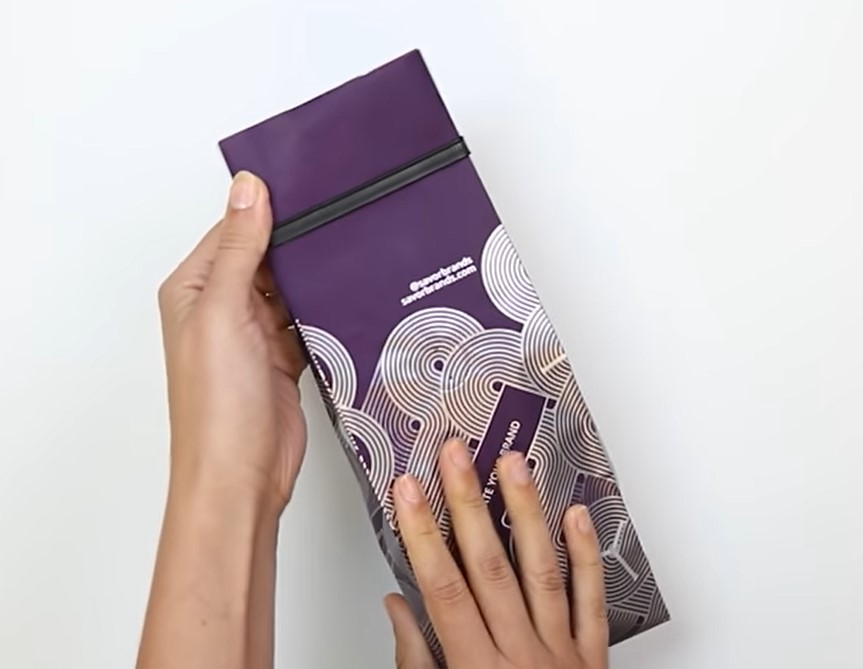
Stand a quad seal box bottom on a table and the base is a formed square, folded and sealed into a flat rectangle the bag can sit on. Stand a V cut next to it and the base is a simple wedge, two panels folded to a point and sealed across. Lay the bag on its side and you can see it clearly: the bottom comes to a V instead of squaring off.
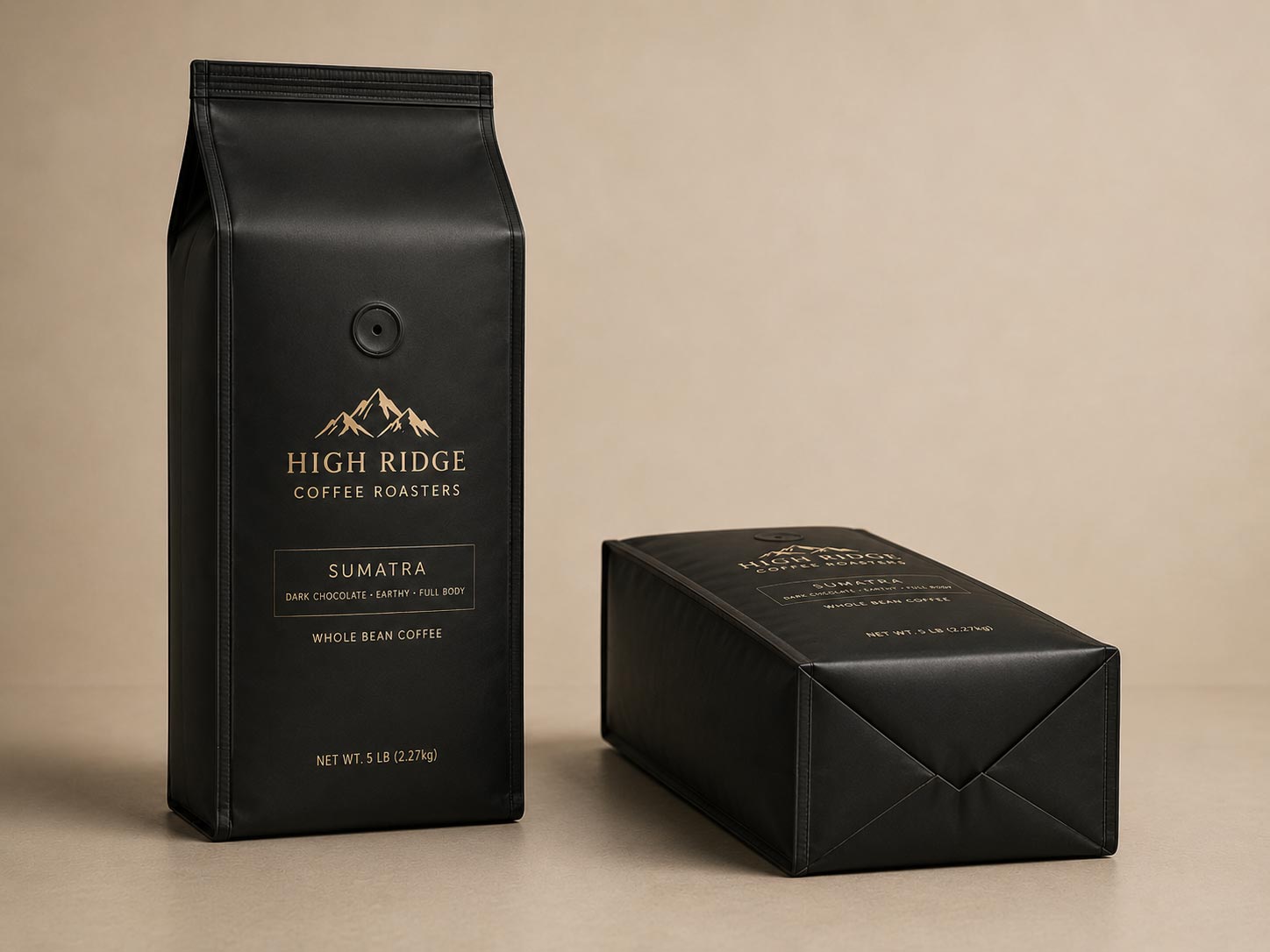
That one difference in the base is the whole story. It is why the bag costs less, why it still stands up on a shelf, and why it has quietly become the default for wholesale sizes.
Quad Seal V Cut: Four Seams, One Flat Face
The quad seal V cut, which you will see written as QSV on a spec sheet, has a reinforced seam running the full height of all four corners. Those seams do two jobs. They make the bag rigid enough to stand and hold its shape as it empties, and they frame the front panel into a flat, square face that prints cleanly and faces forward on a shelf.
That is why our own guides describe the QSV as the flat bottom look at a lower price point. From the front, on a shelf, at arm's length, a customer is not going to tell a QSV apart from a box bottom. The difference is underneath, where nobody is looking.
- Four reinforced corner seams, so it stands without a formed base
- A flat front panel that behaves like a box bottom for print and shelf presence
- A V fold bottom instead of a square gusset, which is where the saving comes from
- Available in the same barrier films and the same closures as the rest of the range
Side Gusset V Cut: The Folded Sibling
The side gusset V cut, or SGV, shares the same V bottom but builds the body a different way. Instead of four corner seams it has a folded pleat down each side. That pleat is what lets the bag expand as it fills, and it gives you the profile most people picture when they think of a coffee bag: a tall panel with a crease running down each edge.
The trade between the two is presence against price. The QSV holds a squarer, more architectural shape. The SGV is softer and folds flatter when empty, which makes it cheaper to ship and store. One of our own posts put it plainly: the side gusset V cut saves money while standing like a quad seal box bottom.
It is also more popular than most roasters assume. When we looked at what Midwest roasters actually order, the two most common styles were the side gusset V cut and the quad seal box bottom. The SGV is not a compromise shape, it is a first choice for a lot of people.
Why It Costs Less
A box bottom base has to be formed. The film is folded into a square, creased on four lines and sealed so it opens into a flat rectangle. That is more material, more folding steps and more places to get it wrong. A V bottom is two panels brought to a point and sealed across, which is fewer steps and less film.
None of that touches the barrier. A V cut runs the same laminates as any other style in the range, so the shelf life you get is set by the film you choose and not the shape you choose. Aluminum still holds nine to twelve months, metallized polyester still runs about six. Our guide to
barrier materials covers what each one buys you.
What you are giving up is the formed base. A V cut stands, but it does not sit as squarely as a box bottom when it is nearly empty, and it will not present quite as crisply in a tight retail facing. For most orders that is a fair trade. For a flagship retail SKU where the bag is doing the selling, it might not be.
The Shape That Owns the 5 lb Bag
Look at what roasters actually put wholesale coffee in and the V cut shows up again and again. Greater Goods Coffee runs two SKUs: a 12 oz quad seal box bottom for retail and a 5 lb quad seal V cut for wholesale. Vail Mountain Coffee does the same thing, a 5 lb QSV for their wholesale accounts.
The logic is straightforward. A 5 lb bag is not competing on a shelf. It goes to a cafe, a restaurant or an office, gets opened in a back room by someone who already bought it, and gets emptied into a hopper within a week or two. Nobody needs the base to be perfectly square. They need the bag to be strong, to hold five pounds without splitting a seam, and to cost as little as possible per unit.
Closures: Sometimes None Is the Right Answer
The V cut takes the same closures as everything else, and which one you pick follows the same wholesale logic. Vail Mountain's 5 lb QSV has no closure at all, and that is deliberate. A wholesale bag that gets emptied into a hopper in one or two goes does not need to reseal, and every closure you add is cost per unit you are handing to a customer who will not use it.
Where resealing does matter, the options are open. Greater Goods puts a resealable pull tab on both their box bottom and their V cut. Captain and Stoker run a
tin tie on their QSV, which folds and holds and suits the scoop-and-pour rhythm of a cafe counter. A
tear notch costs almost nothing and just makes the bag open cleanly.
- No closure for 5 lb wholesale that empties fast
- Tin tie for cafe and back bar bags that get opened daily
- Resealable pull tab or zipper for anything a home customer keeps
- Tear notch on almost anything, because a clean opening costs very little
Which V Cut Should You Order
Start with where the bag ends up. If it is going on a retail shelf and has to hold its own next to forty other bags, the QSV gives you the squarer face and the box bottom look. If it is going to a wholesale account, or if shipping and storage cost matters more than shelf presence, the SGV folds flatter and costs less.
Then check the size. The V cut earns its keep most obviously at 2 lb and 5 lb, where the price difference against a formed base is largest and the shelf argument is weakest. At 12 oz, on a retail shelf, a box bottom is often worth the extra.
- Retail shelf, 12 oz to 1 lb: box bottom is usually worth it
- Retail shelf on a tight budget: quad seal V cut, which reads the same from the front
- Wholesale 2 lb and 5 lb: V cut, and consider skipping the closure
- Cost and freight sensitive at any size: side gusset V cut
The Cheapest Bag That Still Looks Like the Expensive One
The V cut is not a downgrade, it is a decision about where to spend. You are moving money out of a formed base that customers never see and leaving it in the film that protects the coffee and the print that sells it.
If you are working out which style fits which SKU, our guides to
coffee bag dimensions and the
quad seal and flat bottom family cover the rest of the range. Our team at
Savor Brands maps shapes to SKUs with roasters every week, and you can see what we hold ready in
stock bags.