There Is a Date on Your Kona Blend Bag That Is Not Printed on It
If you sell a Hawaii coffee blend, the label on it has a deadline. On July 1, 2027, the minimum amount of Hawaii-grown coffee a blend must contain in order to carry a Hawaii regional name rises from 10 percent to 51 percent. The 10 percent transitional threshold expires on June 30, 2027.
That is a sourcing conversation and a pricing conversation, and both of those are being had. The one that is not being had is the packaging conversation, and it is the one with the earliest deadline. The percentage is printed on the bag. Which means the bag, not just the coffee, has a date after which it cannot be sold.
Twenty months sounds like plenty. It is not, if you are about to place an order that covers eighteen of them.
What Changes, and What Already Changed
It helps to separate the part that is coming from the part that is already here, because a lot of people have these merged.
Already in force since 2024: a blend's identity statement has to show the weight percentage of the coffee from each origin, and those percentages have to add up to 100. That is not a future requirement. If your bag says Kona Blend and nothing else, it is already behind.
Coming on July 1, 2027: the minimum Hawaii-grown content in a blend goes to 51 percent, with compliance required by that date. Separately, the term All Hawaiian stays reserved for coffee that is both grown and processed in Hawaii, decaffeination included.
There is no federal equivalent to any of this. It is Hawaii law, it applies to what you put on the package, and the exact wording your identity statement needs is worth confirming directly with the Hawaii Department of Agriculture rather than taking from a blog post, including this one.
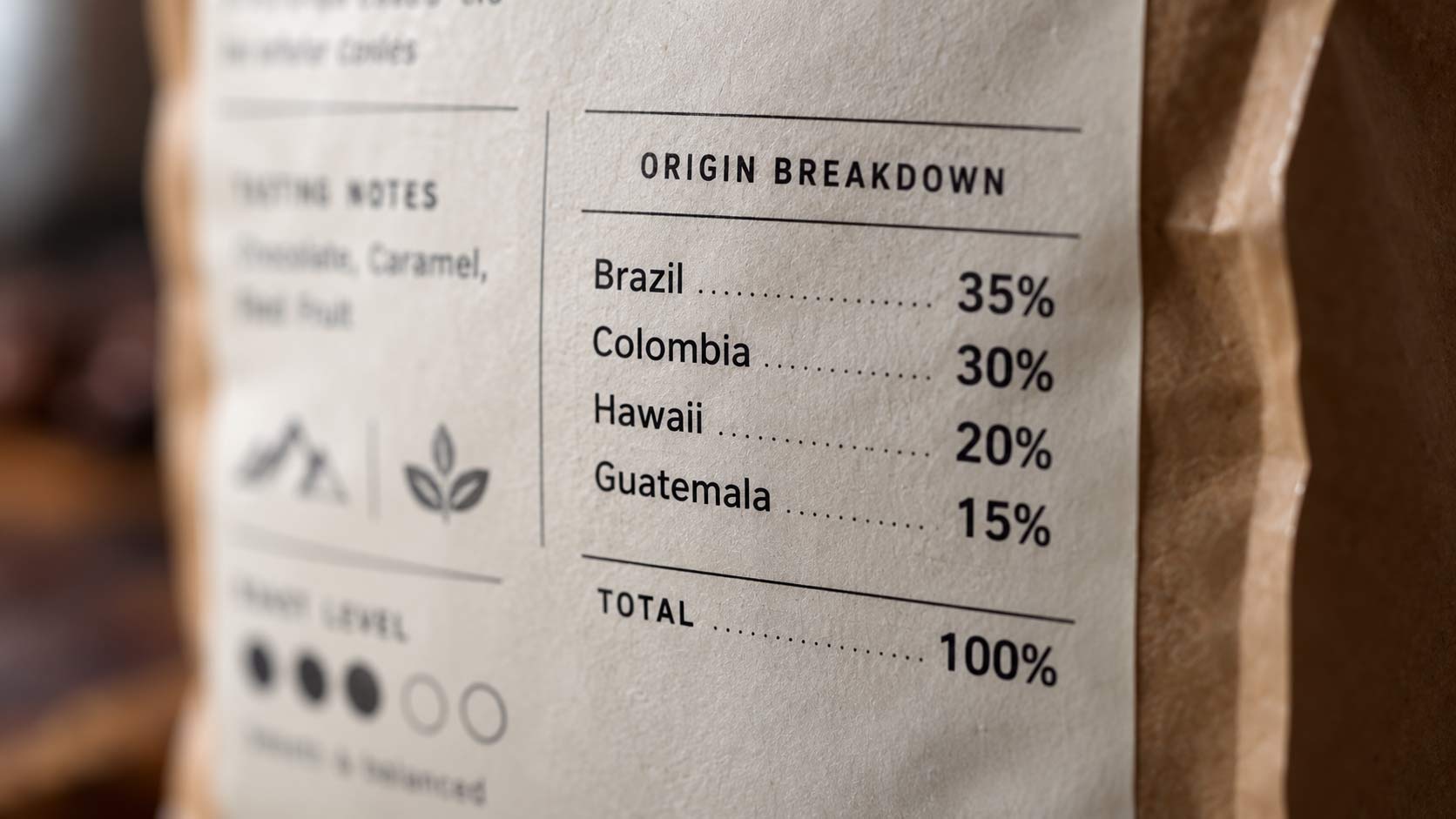
The Percentage Is Artwork, Not Paperwork
This is where it stops being a compliance item and becomes a production item.
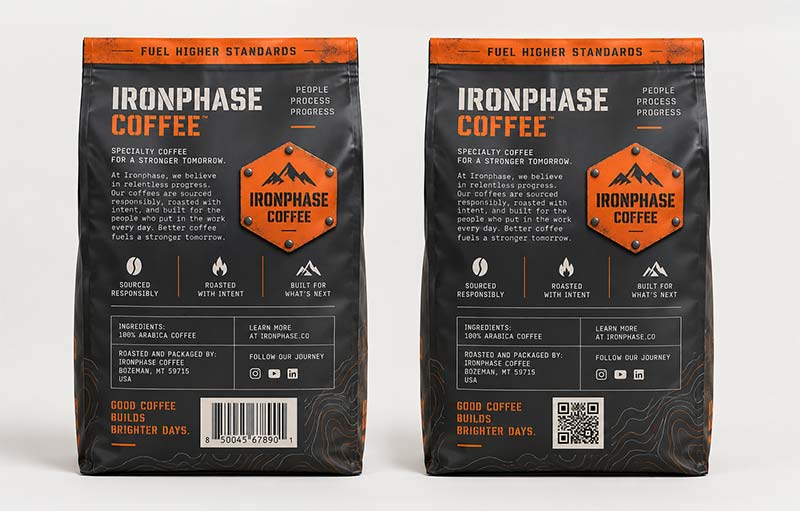
A number printed on a bag is part of the printed design. Changing it means new artwork, a new proof, and a new press setup. On a digitally printed bag that is a modest cost, because the image goes from a file to the press and there is no tooling in between. On rotogravure it is a different matter, because the artwork is engraved into copper cylinders and a change means re-engraving.
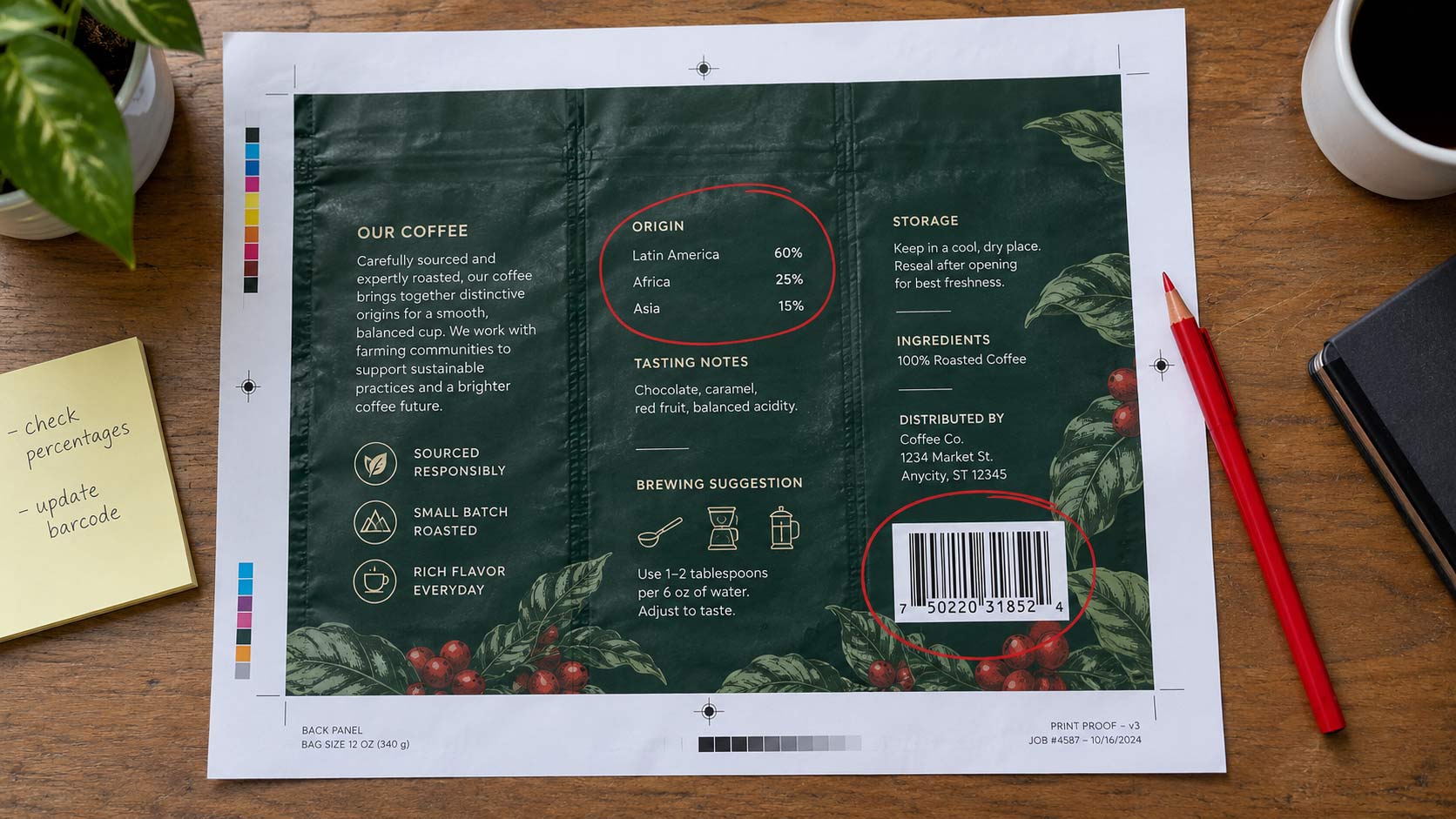
There is a detail worth knowing here that can save you real money. If the percentage sits in a single ink color, usually the black text layer, then only that one cylinder has to be re-engraved rather than the whole set. If the number is sitting inside a multi-color graphic, a reversed-out panel or a photographic area, the change reaches across several cylinders at once. Where the number lives on the design is therefore a cost decision, and almost nobody treats it as one at artwork stage.
How Far Ahead This Reaches
Work the arithmetic backward from July 1, 2027, and the real deadline moves a long way closer.
Take the number of bags you have on hand, add whatever is already on order, and divide by how many you actually use in a month. That tells you the date your current label runs out. If that date lands after June 30, 2027, some portion of what you are holding will not be sellable, and you are going to eat it.
Now do the same for the order you are about to place. A run sized for good economics is usually sized for a long time on the shelf, which is exactly the thing that turns a distant deadline into a near one. The cheaper the bag got per unit, the more months of exposure you bought with it.
None of this is a reason to panic and order small. It is a reason to know the number before the quote rather than after it.
Two 2027 Deadlines, One Reprint
Here is the piece of good news, and it only helps if you notice it in time.
Hawaii is not the only thing changing in 2027. The retail barcode transition we wrote about in
your coffee bag barcode changes in 2027 lands in the same window, and it also touches the printed design. If you are going to pay for new artwork, a new proof and new tooling once, you would much rather it be once.
Brands that handle these separately pay for the same change twice. Brands that look at the whole back panel now, while there is still time to be deliberate about it, pay once and get a better-organized panel out of it. That is the entire argument for starting this in 2026 rather than in 2027.
What to Do Before You Place the Next Order
This is a short list and it is all doable this week.
- Count what you are holding. Bags on hand plus bags on order, divided by monthly usage. That is your real date.
- Decide whether to split the run. Two smaller orders cost more per bag than one large one and can be far cheaper than scrapping a pallet.
- Find out where the percentage sits in your artwork. One ink color or several. This changes what a revision costs on gravure.
- Look at the barcode at the same time. One artwork revision instead of two.
- Think hard before planning to sticker over it. A label applied over a printed claim is legal territory worth checking, some retailers dislike it, and it rarely looks like confidence.
- Confirm your exact identity statement wording with the state rather than copying another brand's bag, because plenty of bags on the shelf right now are not compliant with the 2024 disclosure rule either.
How Savor Brands Handles This
A deadline on a label is a packaging planning problem, and planning is the cheap part.
- We ask how long a run has to last, not just how many you want. Those are different questions and only one of them is on a purchase order.
- We will tell you to order less when a smaller run gets you past a known change without stranding inventory, even though a bigger order is a bigger order for us.
- We lay out the artwork so changeable copy is changeable. Putting regulated text in a single ink color on a gravure job is a decision made once and paid back on every revision.
- Digital is the obvious tool for a transition period. No cylinders means a copy change costs almost nothing, and our minimum is 500 bags, so a short bridge run is a real option rather than a theoretical one.
- We flag the stack of changes together. If two things are going to move your back panel, you should hear about both before you approve either.
Wrapping It Up: Go Count Your Bags
The honest summary is that this is not a hard problem, it is just an easy one to miss, because nothing about a pallet of perfectly good bags looks like a problem.
July 1, 2027 is the date. Your date is earlier, and it is whatever day your current stock runs out, because that is your last chance to change the label without throwing anything away. Work out that day, write it down, and make your next packaging decision against it rather than against the calendar.
If you are not sure which of your SKUs are affected or how your current artwork is built,
send us the bags you are running and we will tell you what a revision actually costs on each one. Our posts on
packaging the Kona harvest and
origin claims and the EU rules cover the two other places where what you print and what you can prove have to line up.