The Ink Is Not on the Outside
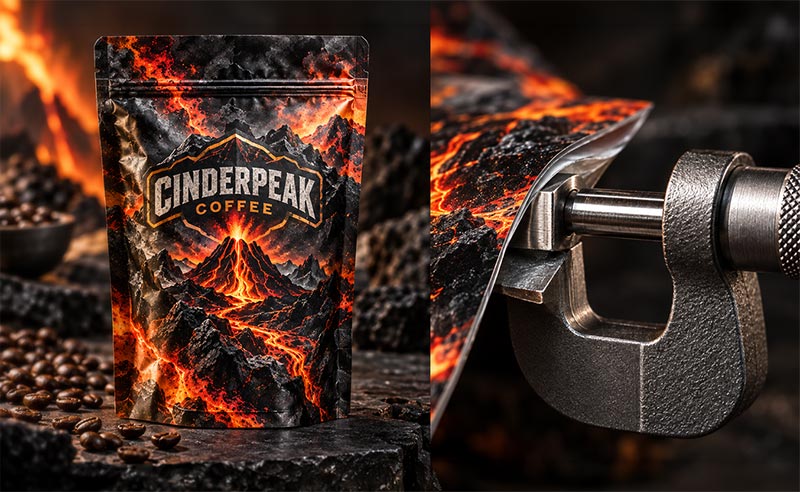
Pick up a high barrier coffee bag and run your thumbnail hard across the logo. Nothing happens. No smudge, no scratch, no colour on your thumb.
Try that on a printed cardboard box or a paper label and you will eventually mark it. So why is the bag different?
Because on most laminated coffee bags,
the ink is not on the surface you are touching. It was printed on the underside of the outer film, and then sealed inside the wall of the bag. You are not touching the print. You are touching a layer of clear plastic that sits on top of it.
How You Print the Inside of Something
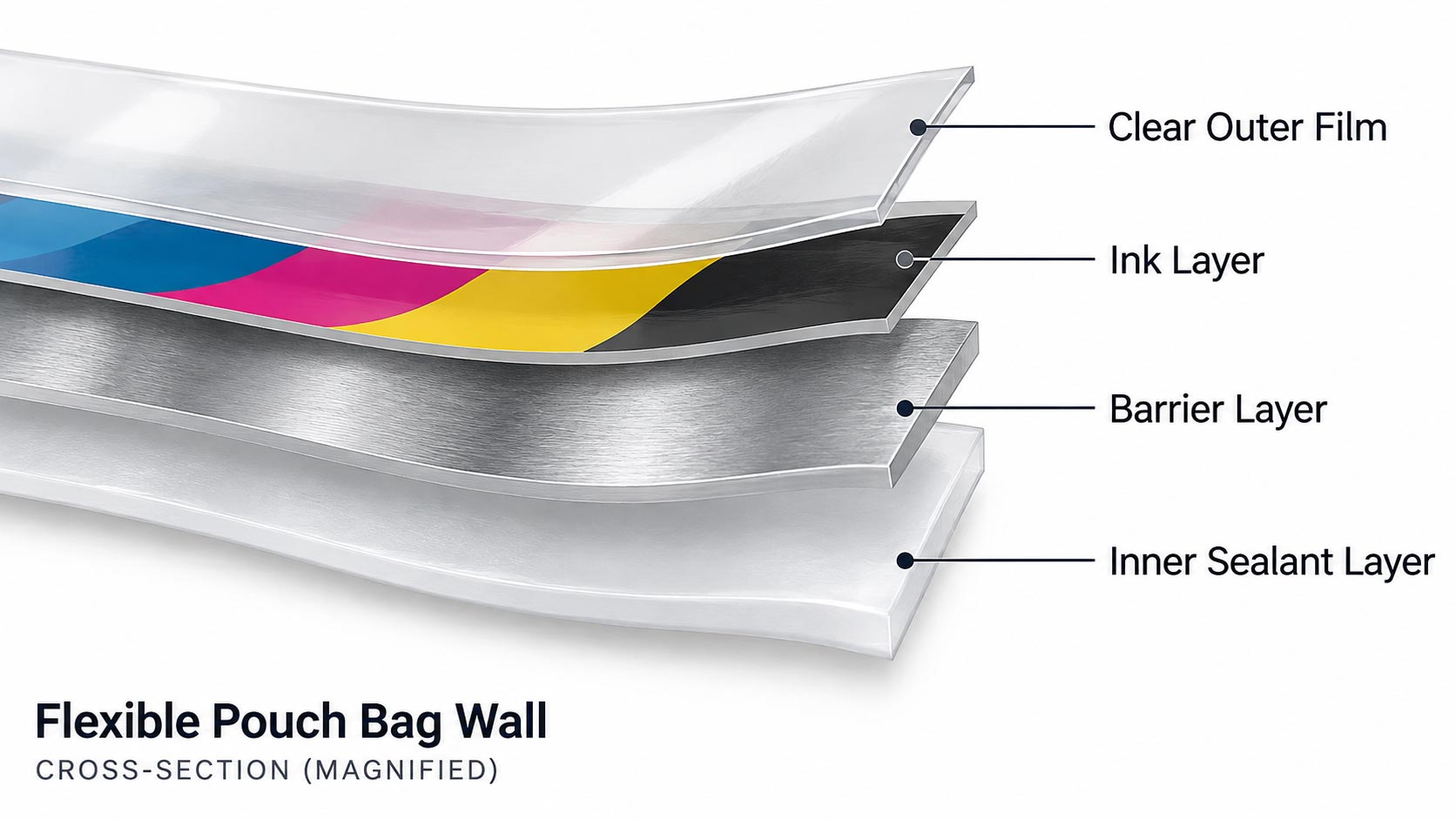
This works because a coffee bag is not one material. It is several layers bonded into a single wall, which we covered in
coffee bag thickness and in the
anatomy of a coffee bag.
The order of operations is the part nobody sees. The outer film arrives clear. The press prints the artwork onto the inner face of that clear film, in mirror image, so it reads correctly when you flip the film over. Then that printed film is laminated to the barrier layer and the sealant layer, with the ink now trapped between the outer film and everything behind it.
By the time the bag is a bag, the print is a filling in a sandwich. This is called reverse printing, and it is the standard for laminated flexible packaging.
What That Actually Buys You
Four things, and they are the reason it is done this way:
- The graphics cannot scuff off. Bags rub against each other in a carton, get handled, get stacked, get dragged across a shelf. The ink is behind a layer of film through all of it.
- The finish comes from the film, not a coating. A gloss bag is glossy because the outer film is glossy. A matte bag is matte because the film is. You are not relying on a varnish that can wear, and that is part of why a soft touch finish feels the way it does.
- The colour is sealed away from the coffee and the world. The ink is not in contact with your product, and it is not exposed to moisture or handling on the outside.
- It survives the things that ruin surface print. Damp hands, a wet cooler, a bag that got rained on between the van and the door.
The Part That Reaches Your Artwork
Mostly this is invisible to you, and the printer handles the mirroring. One consequence does reach the design, and it explains a request that confuses a lot of designers.
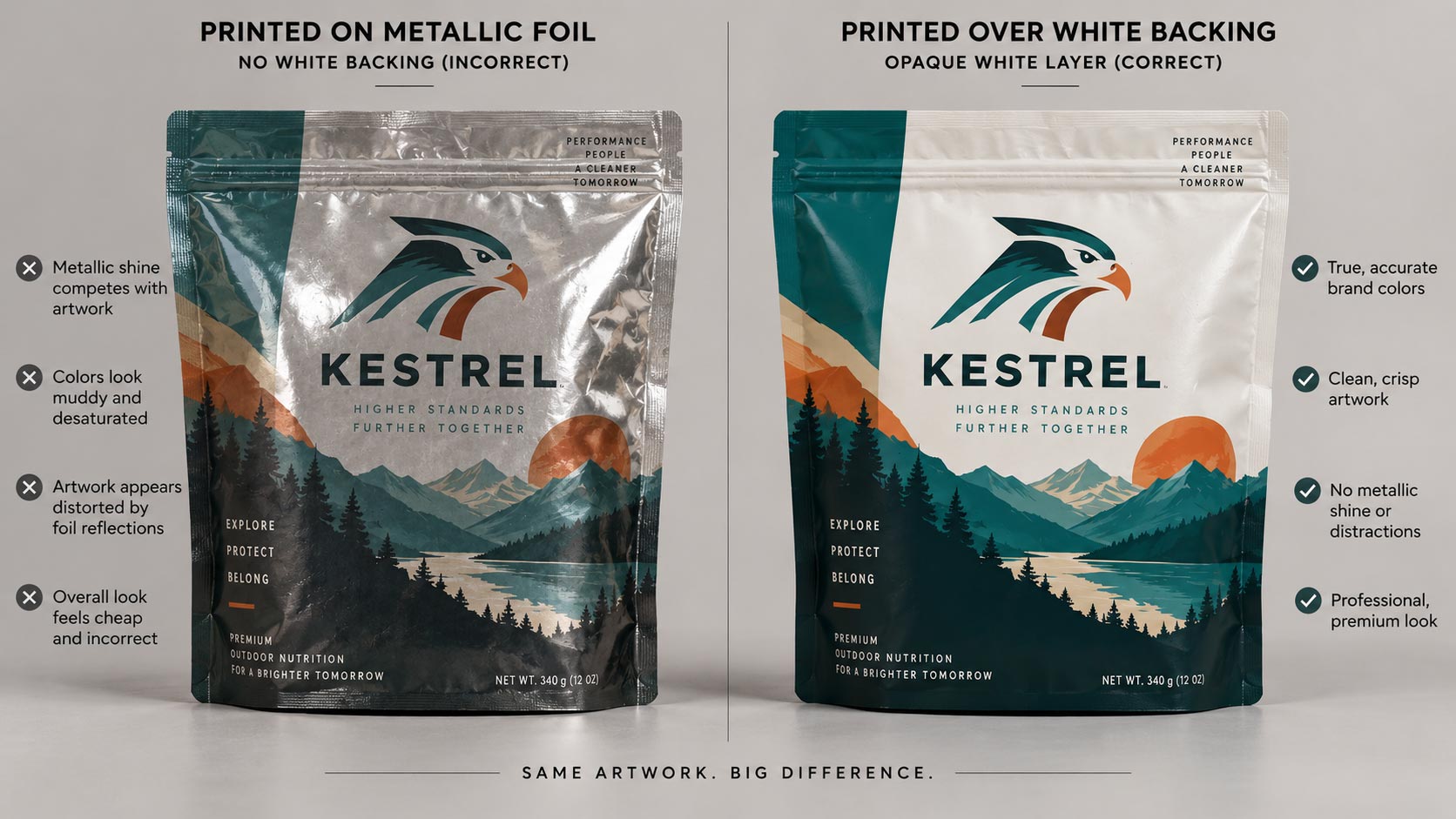
If the layer behind your ink is aluminium foil or a metallized film, your colours are sitting on something silver. Print a mid blue directly onto that and it does not read as your mid blue, it reads as metallic. So a layer of opaque white is usually laid down behind the artwork first, as a backing, and the colours print against white instead of against foil.
That is why you may be asked for a white layer in your file, or asked which areas should stay metallic. Those are not arbitrary questions. They are asking which parts of your design should sit on white and which should let the foil show through, which is a genuine design decision and a good one to make on purpose. A deliberate unbacked area is how you get a metallic accent without paying for a special ink.
Where This Does Not Apply
Two situations, and the second is why kraft looks the way it does.
Surface printing is the other method: ink goes on the outside of the material and a protective overlacquer goes on top of it. It is used where you cannot bury the ink under a clear film, and it is why some packaging does mark if you scratch it hard.
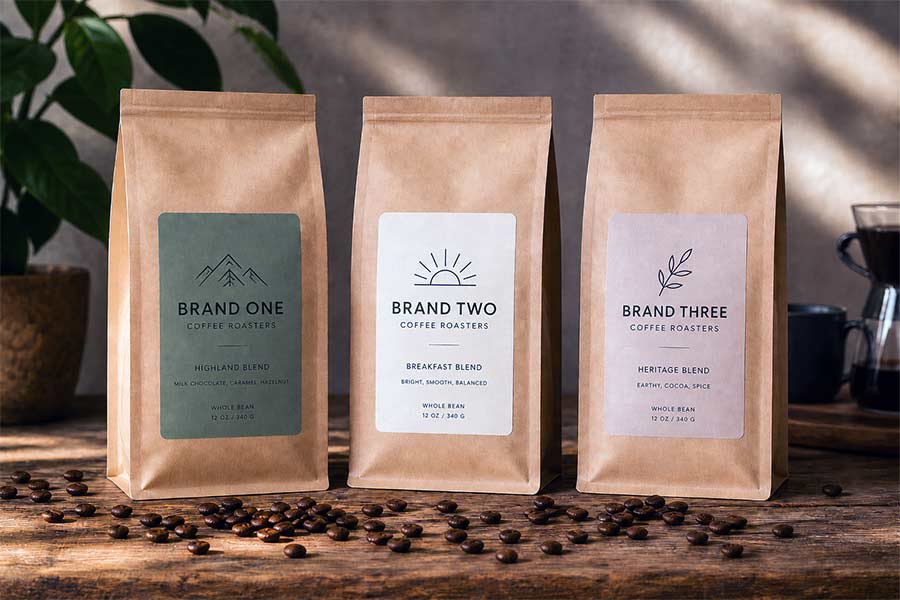
Kraft paper bags are the common case. A kraft bag is paper on the outside with a barrier film inside, and the paper is the thing you want to see and feel, so you cannot hide the print under a clear layer without losing the point. The print sits on the paper. Our
guide to kraft coffee bags covers how those structures are built, and the trade is real: you get the texture, you give up the protection the laminate gives the ink.
Why It Is Worth Knowing
This is not a decision you make. No roaster specifies reverse printing; you get it because you chose a laminated bag.
It is worth knowing for three reasons. It tells you why your bag can go through distribution without the branding degrading, which is not true of every package you buy. It explains the white layer question before someone asks it. And when you are choosing between a laminated film and a paper outer, it tells you one of the things you are actually trading, which is not obvious from a swatch.
If you are specifying a bag and want to know how your particular colours will behave against the layer behind them,
send us the artwork and we will tell you what needs a white backer and what is better left metallic.