Open a Fresh Carton and the Bags Fight You
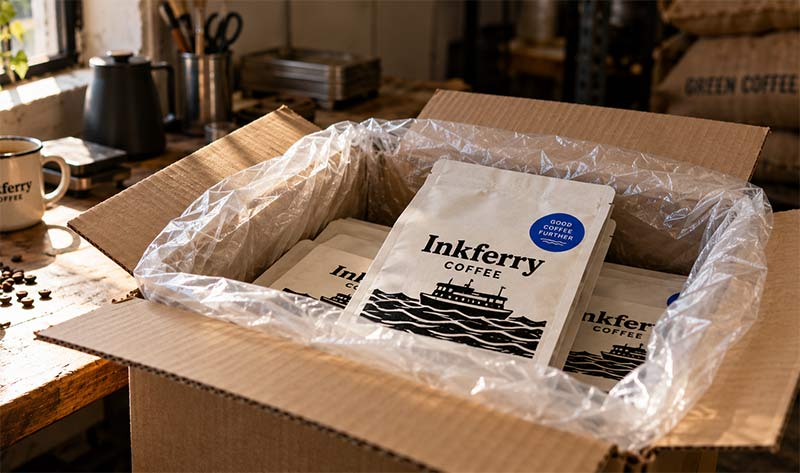
You pull back the poly liner on a new carton, reach in for a stack, and more comes out than you asked for. You peel two apart and they snap back together. A corner lifts off the pile and reaches for your sleeve.
Most roasters file this under humidity, or a bad run, or packaging just being packaging. Then they load the bagger and spend the morning clearing double feeds.
It is not humidity, and the bags are not defective. They are carrying an electrical charge, and that charge is a direct consequence of how recently they were made.
Film Arrives Holding a Charge
When two surfaces touch and then separate, they trade electrons. One side ends up with a surplus and the other with a deficit, and the difference is a static charge. It is the same effect as a balloon on a jumper, and it has nothing to do with the weather.
Now count how much separating happens to a coffee bag before it reaches you. Film is unwound from a roll. It runs over rollers. It is laminated to another web, wound again, cured, slit, unwound a third time, formed, sealed, cut into bags, stacked, and sealed inside a poly liner. Every one of those steps is two surfaces parting company.
On a metal surface the resulting charge drains away the moment it touches anything grounded. Polyethylene is one of the best electrical insulators we put food into, which is exactly why it makes a good barrier, and exactly why the charge has nowhere to go. It sits on the surface of your bags and waits.
What the Charge Actually Costs You
The symptom everyone notices is bags clinging. The problems that cost you money are further downstream.
- Double feeds. Two bags move as one, so an operator loads a double without seeing it, or an automatic bagger takes a pair and jams. Either way the line stops.
- Coffee fines pulled to the worst possible place. A charged bag attracts the dust coming off your own product, and it collects on the open top, which is precisely where you need clean film touching clean film a second later. That is a direct route to a weak seal, which we covered in why coffee bag seals fail.
- Room dust on a food surface. The charge does not care whether the particle is coffee or warehouse grit.
- Labels landing crooked. The bag shifts as the label approaches it, which is maddening and very hard to diagnose if you do not know why.
- Slower handling. Everything takes longer when every stack has to be fanned apart by hand.
None of that reads as a packaging problem while it is happening. It reads as a bad morning.

The Only Real Thing That Fixes It Is Time
Static dissipates on its own. The charge bleeds off into the air, helped along by normal ambient humidity and by contact with anything grounded.
You can speed that up. Ionizing bars and anti-static equipment on a filling line do exactly this job, and a room that is not bone dry helps more than people expect. Those are worth having if you run volume.
But the plain, unglamorous truth is that the most reliable way to get the charge out of a carton of bags is to let them sit. A bag converted this morning and shipped this afternoon arrives at your door holding everything it picked up on the line. A bag that has had time to rest in a normal environment mostly does not.
Why Our Lead Time Looks Longer Than Someone Else's
This is the part worth saying plainly, because it genuinely costs us orders.
We build settling time into our schedule on purpose. Laminated film needs its adhesive to fully cure, which is a chemical process on its own clock and the subject of
why your bags spend more time curing than printing. Converted bags then need time to shed the charge they picked up and to relax out of the shape the roll put them in. Fresh laminate also has a faint smell that wants to air off, which we wrote about in
your new bags have a faint smell.
Not one of those shows up on a spec sheet. All of them show up in your filling room.
So when you put our date next to a quote that is dramatically shorter, you are not just comparing speed. You are comparing what each supplier decided to do with the days in between. We get pushed on this, and we have lost work over it, and we are not going to change it. We would rather you open the carton and have the bags behave.
Fair Questions for a Much Faster Quote
A shorter lead time is not automatically a worse bag. Different plants run different equipment, and some genuinely are faster. These are reasonable things to ask before you decide.
- Is the laminate fully cured before the roll is converted, or does the schedule assume it finishes curing on the way to me?
- Do finished bags rest before they are packed, or are they boxed straight off the converting line?
- If I open a carton and the bags cling badly, what is your position on that?
A supplier with a good answer will have one ready. The question itself is not rude, it is the same question you would ask about green coffee or a roast curve.
What You Can Do on Your Side
Some of this is yours to control, and it is all cheap.
- Open the liner when the carton lands. Let the bags breathe for a few days before you commit a run to them, especially if they travelled fast.
- Store them somewhere normal. A very dry, heated warehouse keeps a charge alive far longer. Our post on storing unfilled coffee bags covers the rest of the conditions that matter.
- Fan the stack before loading. Separating bags by hand once, deliberately, beats clearing jams all morning.
- Ground your equipment. If your bagger is not properly grounded, it is holding a charge too.
- Do not fill straight off a cold truck. Let the pallet come to room temperature first, which solves several problems at once.
Why It Is Worth Knowing
This is a small thing that hides behind big ones. A morning of double feeds gets blamed on the bagger. A weak seal gets blamed on the sealer, or on the bag, or on whoever was running the line. The actual cause can be an invisible electrical charge that was always going to fade on its own if anyone had given it a few days.
Knowing that changes two decisions. It changes what you do with a carton the day it arrives, which costs you nothing and saves you a morning. And it changes how you read a lead time, because the gap between two quoted dates is often the exact gap between a bag that behaves and a bag that does not.
If you are comparing packaging quotes and want to know what is actually happening inside our schedule,
ask us. We will tell you exactly where the days go.