One Bag, Several Coffees
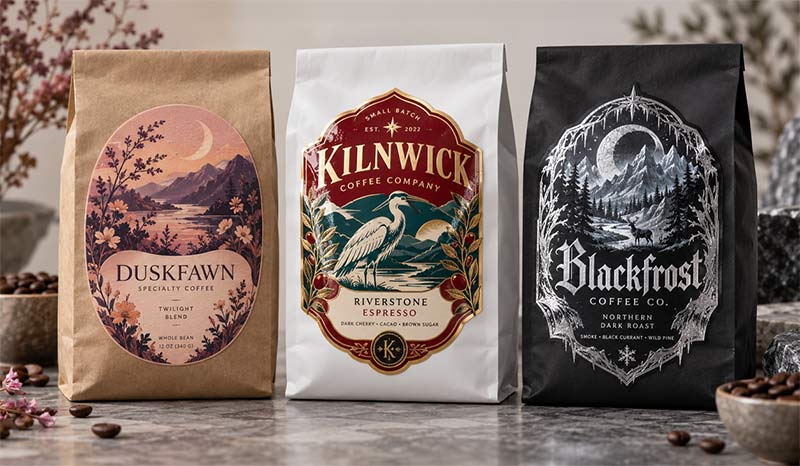
Big Island Coffee Roasters runs a deep teal bag with a wild boar crest on the front. Kona Bloom and Kona Moon are different coffees, one a medium light and one a dark roast, with completely different tasting notes. They are the same bag.
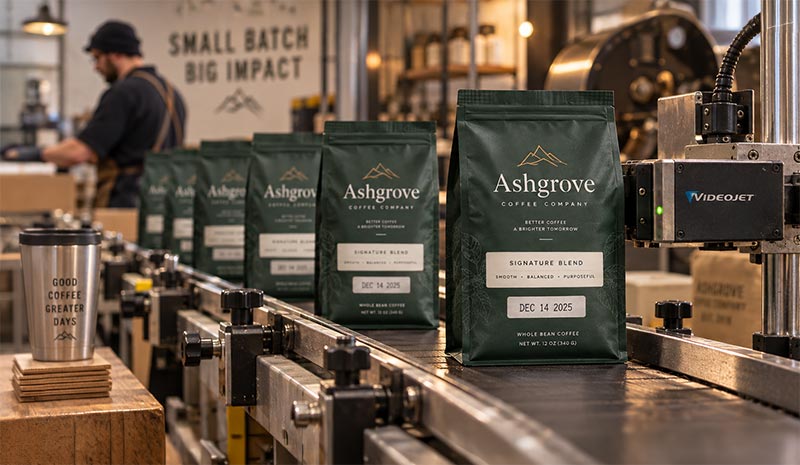
What separates them is a white wrap that comes over the top of the bag and down the front, carrying the coffee name, the roast level and the tasting notes. Change the wrap, change the product. Coava Coffee Roasters does the same thing with a cream band down a sage green bag, and leaves a blank line that simply reads "Roasted:" for the date to be added at fill.
Both are Savor Brands customers, and both are doing the thing we end up recommending to most growing roasters: print one beautiful bag, and let a sticker carry everything that changes.
The Four Shapes a Wrap Can Take
"Belly band" gets used for all of these, but they are not the same object and they do not fit the same bags.
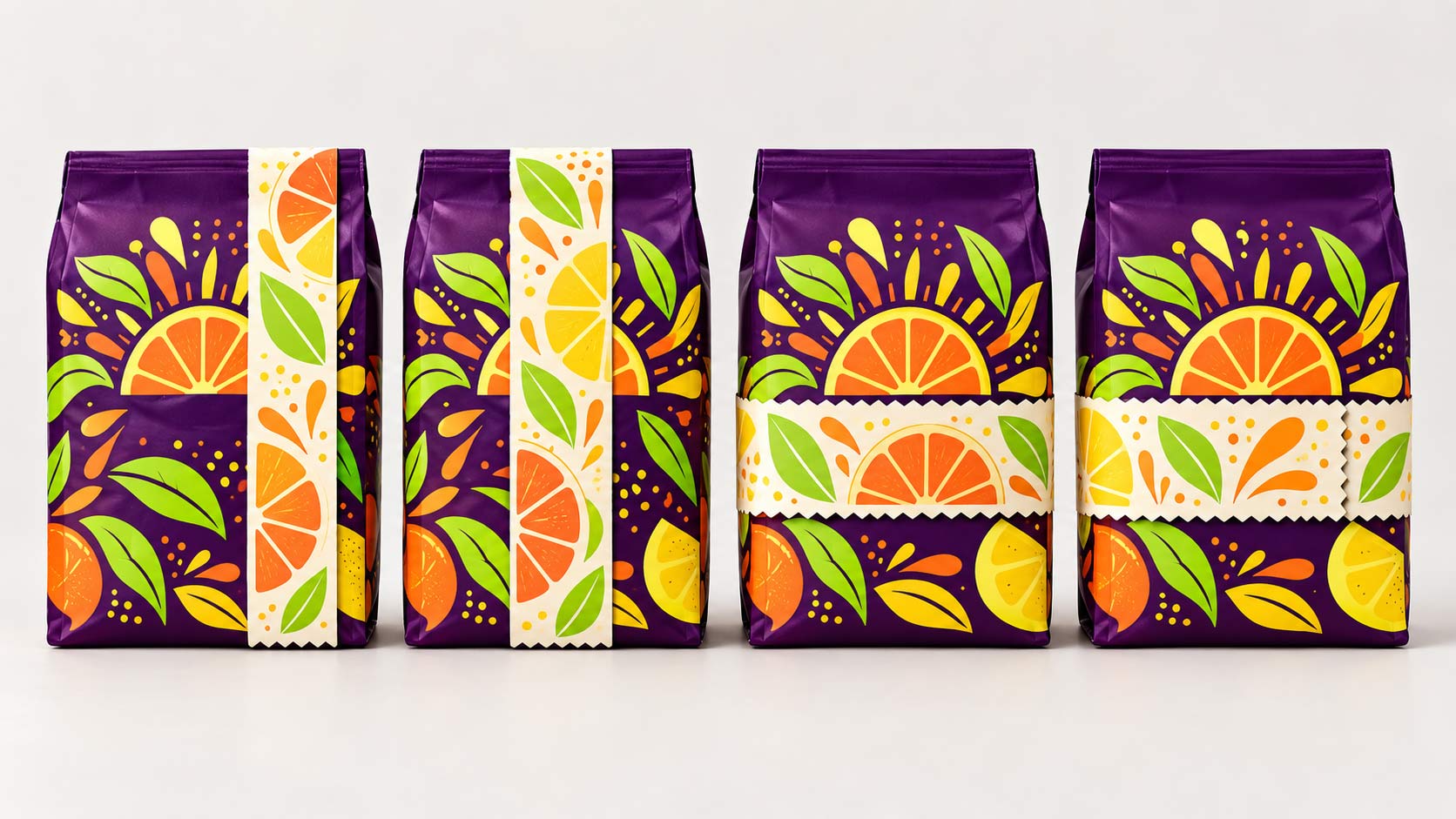
- Vertical half wrap. Comes over the top seal and down the front only. The simplest of the lot and the one both bags above use.
- Vertical full wrap. Over the top and down both the front and the back, so you get two printable faces.
- Horizontal half wrap. Across the front and partway around the sides, stopping before it meets itself.
- Horizontal 360. All the way around the bag, front, sides and back, meeting itself at the seam.
The vertical ones are easy. The horizontal ones are where bag style starts deciding for you, and that is the part nobody explains before you have already designed one.
Why a 360 Band Is Harder Than It Looks
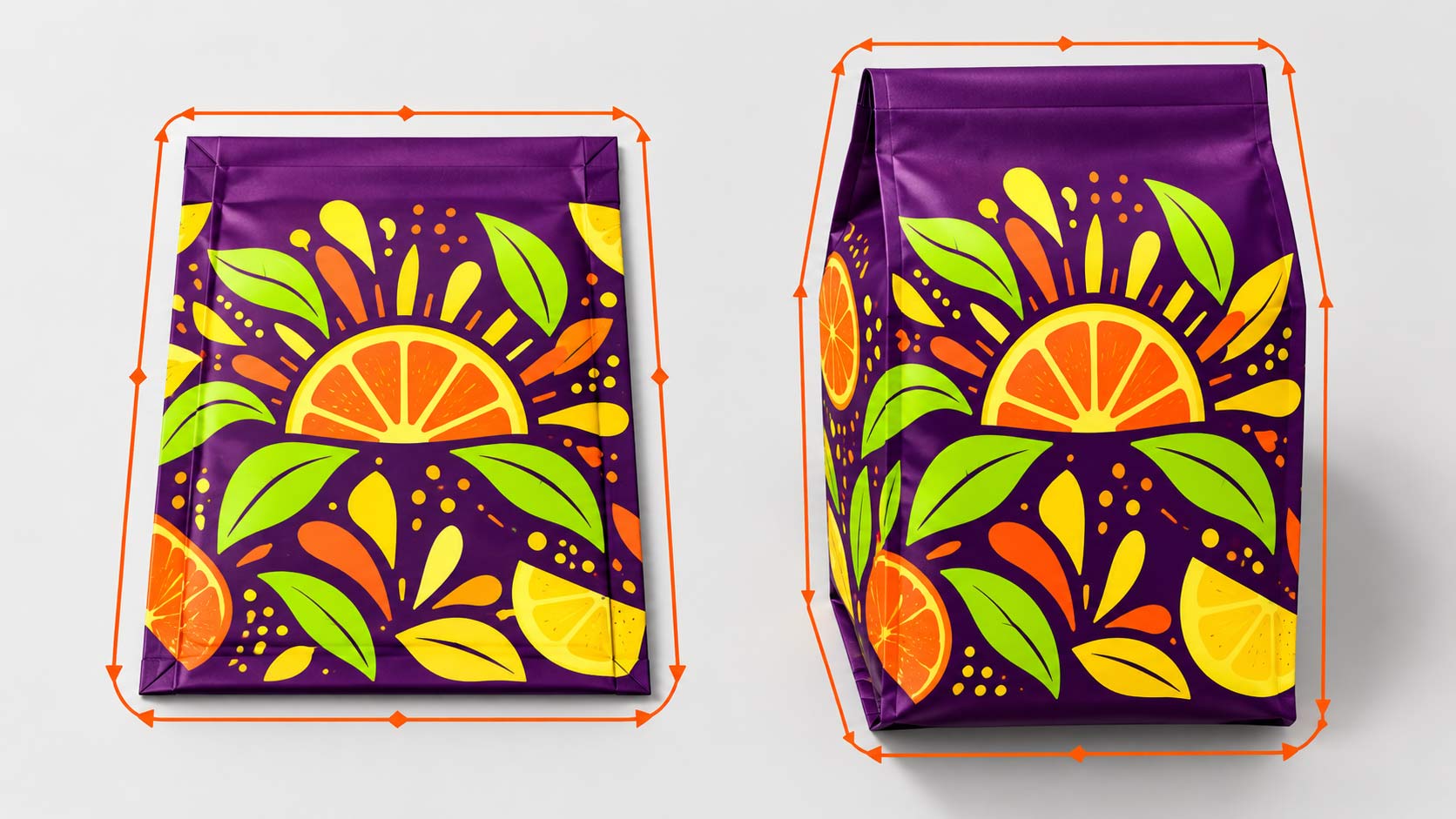
Here is the part that catches people. A wrap is printed and die cut flat. The bag it goes onto is flat when you apply it and three dimensional once it is filled. Those are two different shapes, and on some bag styles they are two very different measurements.
Lay an empty side gusset or quad seal bag on a table and the gussets are folded in. Fill it and those gussets open out, and the distance around the bag grows. A horizontal band sized to the flat bag will be too short once the bag is full. A band sized to the filled bag will hang loose and buckle if you apply it flat, which is how most people apply them.
It is the same trap as the one in
approved flat, printed on a curve, just with a separate piece of paper instead of printed artwork.
A vertical wrap sidesteps all of this. It crosses the top seal, which is flat and stays flat whether the bag is full or empty, so its length does not change when the coffee goes in. That is why the examples you see in the wild, including both of ours, are nearly always vertical.
Which Bags Take Which Wrap
This is the short version of a conversation we have often.
- Flat bottom and quad seal. Great for vertical wraps. A horizontal band has to cross four hard corners, and a crease that lands slightly off a corner looks like a mistake. Doable, but it needs the band sized to the filled bag and applied after filling.
- Side gusset. The biggest gap between flat and filled, so a 360 band is the hardest here. Vertical works well.
- Stand up pouch. Rounder and more forgiving when filled, so a horizontal half wrap across the front panel sits reasonably flat. A true 360 still has to deal with the base.
- Flat or pillow pouch. No gussets, so flat and filled are close to the same shape. This is the one style where a 360 is genuinely easy.
If you want a horizontal band, say so before the bag style is locked, not after.
What the Wrap Should Carry
The useful rule is that the bag holds what never changes and the wrap holds what does.
The bag gets the brand, the logo, the colour, the barrier and the valve. The wrap gets the coffee name, the roast level, the tasting notes, the origin, the processing method and the weight if you run more than one size. Look again at Coava's band and you can see the whole list on it, right down to the blank "Roasted:" line that solves the problem we wrote about in
the roast date post, since that date does not exist when the bag is printed.
Done this way, a seasonal release or a new single origin is a sticker order, not a packaging order.
What It Costs You, Honestly
Two things, and neither is a dealbreaker if you know about them going in.
You are adding a step. Somebody has to apply each wrap, and applied by hand they will not all sit at the same height. That is fine at small volume and it becomes a real labour line as you grow, which is usually the point at which a roaster starts asking about printing the variants directly. Our post on
running SKU variants on one roll stock run covers what that switch actually involves.
And the wrap covers part of a bag you paid to print. A band down the middle of the front panel removes the middle of your front panel. Design the bag knowing where the wrap lands, rather than designing a beautiful front and then covering it.
The material choice matters too, because a wrap that curls at the corners or fights a matte film undoes the premium you were going for. We went through the options in
label materials and finishes.
Pick the Shape Before You Pick the Art
A wrap-around sticker is the cheapest way to turn one printed bag into a product line, and the reason it works is that it separates what is permanent from what changes.
Decide early whether yours goes vertical or horizontal, and whether it is a half wrap or a full 360, because that decision is tied to the bag style and the bag style gets locked first. If you are weighing it up,
tell us the bag style you are leaning toward and how many coffees you want it to cover, and we will tell you which wrap will actually sit right on it.