Every Printer Quotes a Minimum. Almost Nobody Explains One.
If you are starting a coffee brand, the minimum order is usually the first number that stings. You ask for 200 bags and hear 500. You ask for 1,000 and hear that the cheap price starts at 10,000. It is easy to read that as a sales tactic, a way of making you buy more than you need.
It is not, and once you can see what a minimum is actually made of, you stop arguing with the number and start using it. A minimum is the point where the fixed cost of getting a job onto a press stops swamping the cost of the bags themselves. That fixed cost is physical. It is tooling, it is film that gets thrown away before the first good bag, and it is machine time spent changing over. None of it shrinks just because the order does.
We wrote the plain tier guide in
500 to 10,000: coffee packaging minimum order quantity. This post is the part underneath it: why those numbers are where they are, and why we keep ours small on purpose.
Part One: Tooling You Pay For Before the First Bag
On a rotogravure press, your artwork is engraved into copper-plated cylinders, one cylinder for each ink color. A six-color design is six cylinders, and every one of them is built for your bag before a single impression is printed. We went deep on how that works in
rotogravure, explained.
The important part for a new brand is simple. That tooling costs the same whether you print 10,000 bags or 100,000. Spread across a big run it nearly disappears. Spread across 500 bags it would be most of the price of every bag.
A digital press has no cylinders at all. The artwork goes from a file straight to the press. That single difference is the main reason a digital minimum can sit at 500 and a gravure minimum cannot.
Part Two: The Film You Throw Away Getting Up to Color
This is the part almost nobody outside a print plant knows about, and it explains a lot.
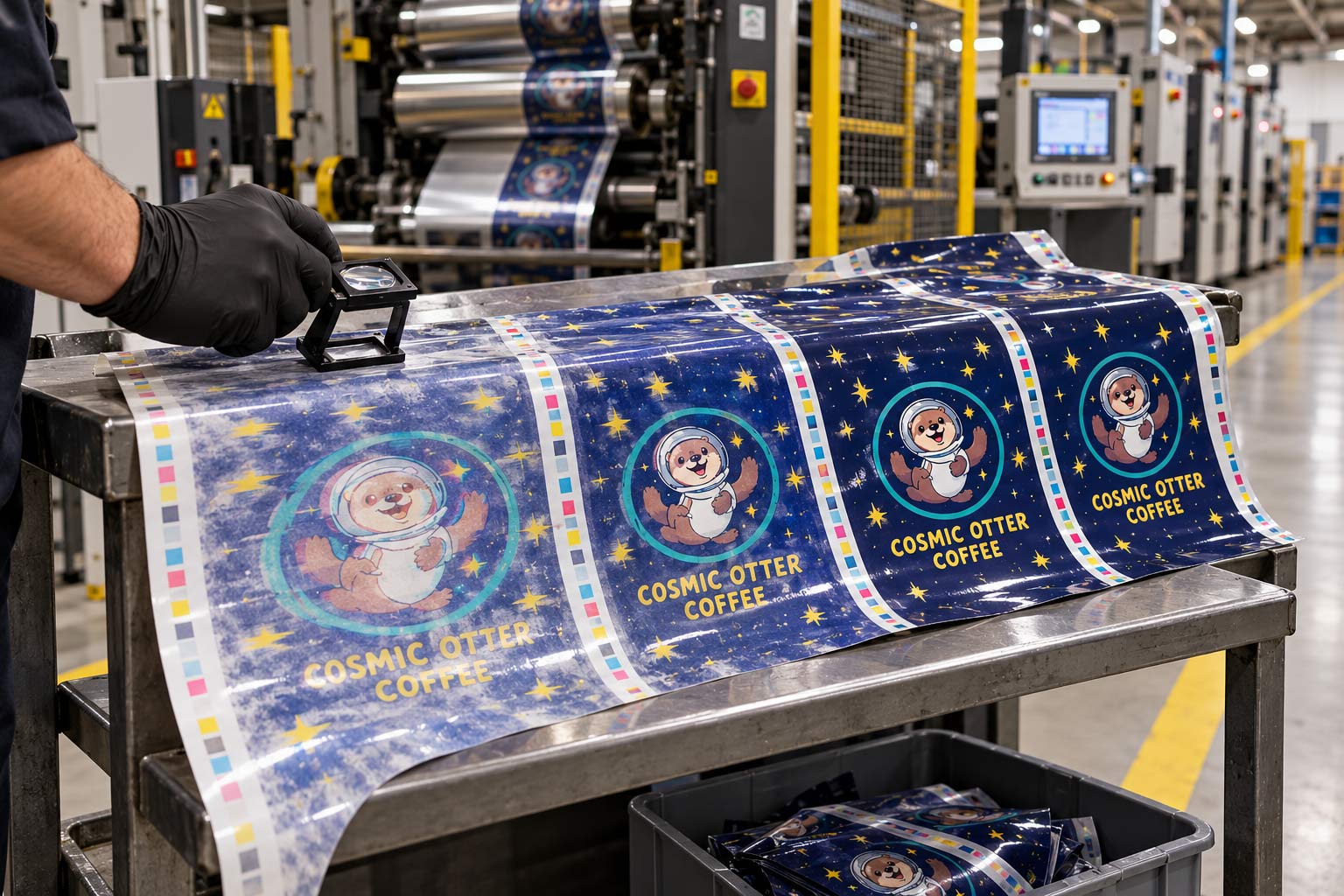
A gravure press does not print a perfect bag the moment it starts. The press has to be threaded with film, brought up to speed, and then adjusted while it runs until every color is the right density and every color lands exactly on top of the others. All the film that runs through the press during that adjustment is scrap. It has your design on it, and it goes in the bin.
That startup waste is roughly the same for every job, because it is the cost of getting the press right, not the cost of the order. On a long run it is a small slice of the total. On a short run it could be more film than the order itself. That is a very practical reason gravure cannot go down to 500: you would be paying to print and throw away more bags than you kept.
Digital printing has far less of this, because color comes from the file and the press is calibrated rather than tuned by hand on your job. Less startup waste is a big part of what makes a small order make sense on digital.
Part Three: The Roll, the Laminator and the Bag Machine
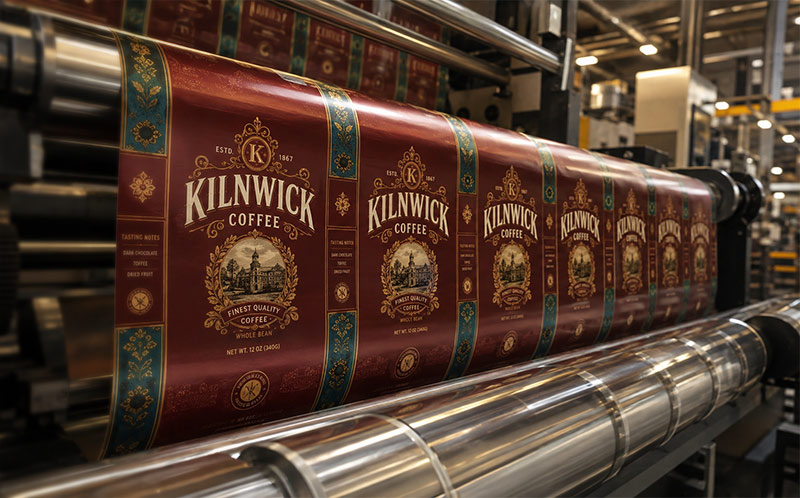
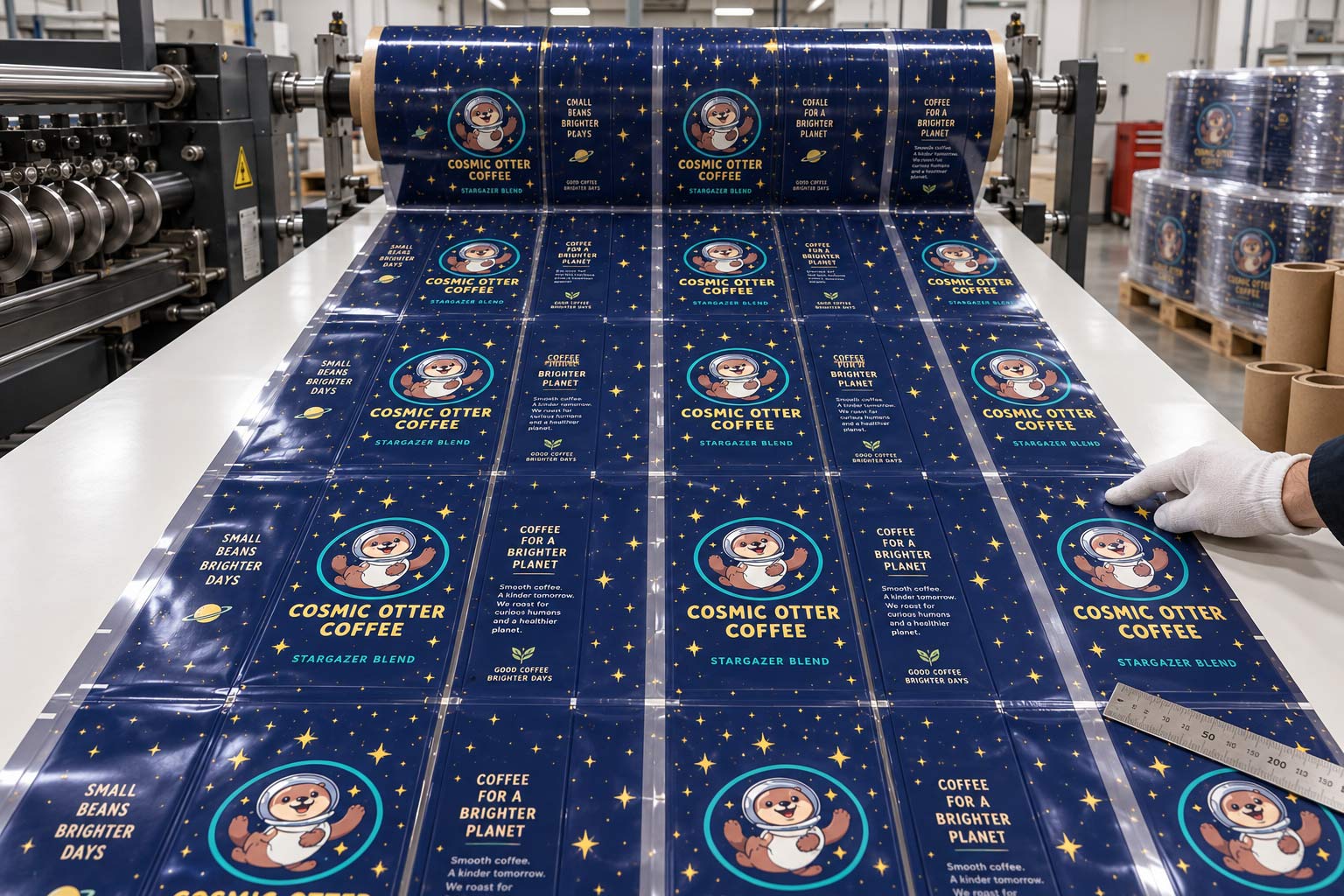
A coffee bag is not printed one bag at a time. It is printed on a wide roll of film, several bags across and many bags along, and the printed roll then goes on a journey.
It is laminated to the barrier layers that keep your coffee fresh, and that laminate has to cure before it can be made into bags, which we covered in
why your bags spend more time curing than printing. Then it is slit into lanes and run through a bag-making machine that seals the sides, sets the gusset, adds the zipper and fits the valve.
Every one of those steps has its own setup. The laminator has to be threaded and started. The bag machine has to be changed over for your size, your zipper and your valve. Those changeovers take the same time whether the job behind them is short or long, and some film is lost at every start.
So when you see a minimum, you are looking at three setups stacked on top of each other: the press, the laminator and the bag machine. The minimum is simply the run length where those setups stop being the biggest thing you are paying for.
Why 500 Is Per Design
This also explains a rule that surprises people. Our 500-bag digital minimum is per design. Two designs at 250 each are not one order of 500.
Each design is its own job. It is its own file, its own setup on the press, and its own changeover on the bag machine. The setup cost does not care that the two designs are on the same purchase order, so the minimum cannot either. We explained the same rule for boxes in
custom boxes now start at 500.
What This Means If You Are Just Starting
Once you can see the pieces, the minimums stop looking arbitrary and start looking like a map.
- Start on digital. No cylinders, little startup waste, and a 500-bag floor. You can launch a real, fully printed bag without a garage full of inventory.
- Order what you can actually sell. A smaller order costs more per bag, but it is far cheaper than a pallet of bags with a design you have already outgrown.
- Learn on the small runs. Your first and second orders are where you find out what customers notice, which size moves and what your back panel really needs to say.
- Watch your volume per design, not your total. Gravure starts to make sense when a single design is selling in the range of 10,000 bags, not when your whole range adds up to that.
- Design for the move. Artwork built with gravure in mind, clean color separation and regulated copy in one ink color, moves across without starting over.
How Savor Brands Grows With You
We keep our digital minimum at 500 bags on purpose. A lot of the brands we work with started with one coffee, one size and one design, and a low floor is what let them start at all.
- Your first order is a real custom bag. Not a sticker on a stock bag, unless that is what you want. Fully printed, from 500.
- We will tell you to order less when a smaller run is the smarter move, even though a bigger order is a bigger order for us.
- We tell you when gravure starts to pay. When one of your designs reaches the volume where cylinders and startup waste become a small slice of the run, we will show you the numbers side by side.
- Same team, every stage. The people who printed your first 500 bags are the people who move you to 10,000. Your files, your sizes and your history stay with you.
- Honest lead times. Custom bags take 9 to 12 weeks after artwork approval, production plus shipping to your door, so we plan reorders with you before you run out.
Our guide to
scaling from your first 500 bags to 50,000 walks through what changes at each stage.
Wrapping It Up: The Minimum Is Where You Start
A minimum is not a wall to get over. It is a reading of what a job physically costs to set up, and once you know that, you can choose the right press for where your brand is today rather than where it might be in three years.
Start small, sell through, learn and reorder. When a design earns it, move it to gravure. That is the path most of the brands on our shelves have taken, and the low minimum is there so you can take it too.
If you are planning your first bag,
tell us what you are launching and we will tell you what a 500-bag first order looks like, and what your next step after it should be.