Does Your Coffee Bag Need a Prop 65 Warning?
For plain roasted coffee, almost certainly not. In 2019 California adopted a rule that treats the chemicals created by roasting and brewing coffee as posing no significant cancer risk, so coffee on its own does not need a Proposition 65 warning on that basis. You may still need one if you add certain ingredients, or if a material in the bag contains a listed chemical. The honest answer is "it depends on what is in and on the product, not on the coffee," so this post walks through how to decide, and how to print the warning so it reads cleanly if you do need it. None of this is legal advice; confirm your own obligations against the regulation or with an attorney.
What Is Prop 65, and Who Has to Follow It?
Proposition 65 is California's Safe Drinking Water and Toxic Enforcement Act of 1986. It requires a business to give a "clear and reasonable warning" before it knowingly exposes a person in California to a chemical the state has listed as causing cancer or reproductive harm. The list is long, close to a thousand chemicals, and it grows.
Two things surprise roasters. First, it follows the product, not your address. If you have ten or more employees and your coffee reaches a customer in California, you are in scope whether you roast in Portland, Austin or Honolulu. Businesses with fewer than ten employees are exempt from the warning requirement. Second, it is enforced not only by the state Attorney General but by private enforcers, who send a "60-day notice" and can sue. That is why you see the warnings everywhere: companies add them defensively. More is not always better, as we will get to.
Why Do People Think Coffee Needs a Warning?
Because roasting coffee creates acrylamide, and acrylamide is on the Prop 65 list. In 2018 a California court ruled in a long-running case that coffee sellers had not proven their defense and would have to warn. For a while it looked like every bag of coffee sold in California would carry a cancer warning, and that is the story most roasters half-remember when they get nervous.
What most people do not hear is the ending.
Why Plain Coffee Does Not Need One
The state's own science agency, OEHHA, responded by writing a regulation. It says that exposures to listed chemicals that are created by and inherent in the roasting or brewing of coffee pose no significant risk, so they do not require a Prop 65 warning. The reasoning leaned on the wider body of research, including the World Health Organization's cancer agency finding that coffee drinking is not classifiable as a cancer cause and is tied to lower risk for some cancers. The rule was adopted in 2019 and it is the reason you can buy coffee in California today without a warning on the bag.
So straight roasted coffee, whole bean or ground, is covered. The acrylamide your roast creates is the exact thing the rule is about.
When Might You Still Need One?
The warning question moves off the coffee and onto everything else about your product. Ask yourself three things:
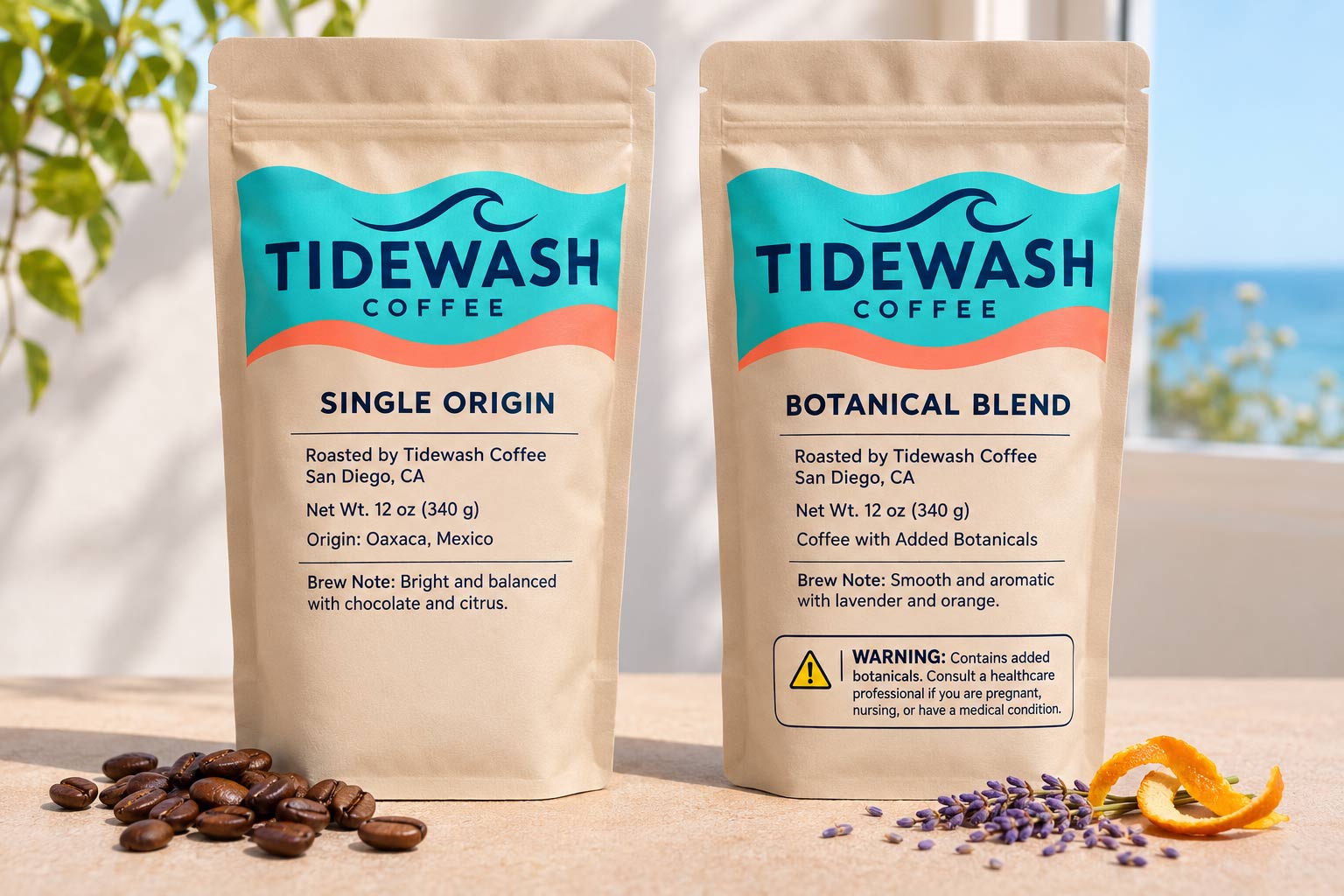
- Did you add anything? A plain single-origin roast is one thing. A blend with added botanicals, some natural or artificial flavorings, or a functional "mushroom" or supplement ingredient is another, because the added ingredient is not covered by the coffee rule and has to be judged on its own.
- Could a contaminant ride along? Some add-ins, certain botanicals and spices among them, have drawn Prop 65 attention for trace lead or cadmium. That is about the ingredient, not your roasting.
- What is the packaging made of? Prop 65 can also reach a chemical in a product's materials. For packaging, that is a materials-compliance question for your bag maker, who should know what is and is not in the film, inks and closures they sell you. Ask them directly.
The thread through all three: the trigger comes from what you
add to the coffee and what your
materials contain, not from the roasted bean. If you sell nothing but roasted coffee in a compliant bag, you are very likely in the clear. The more you add, the more worth a careful look, and for an added-ingredient or supplement product it is worth a real compliance check rather than a guess.
Do Not Slap On a Warning You Do Not Need
It is tempting to add the warning "just in case." Resist it. A cancer warning on a bag of plain coffee tells a shopper your product might be dangerous when the state has specifically said the coffee is not the issue, and that is a real cost on a shelf where the bag next to yours has no warning. Over-warning also is not a free pass; the point of the law is an accurate, meaningful warning, not a reflexive one on everything. Decide on purpose. If you conclude you do not need one, keep a short note of why, so the decision is documented if anyone ever asks.
If You Do Need One, It Lives on the Bag
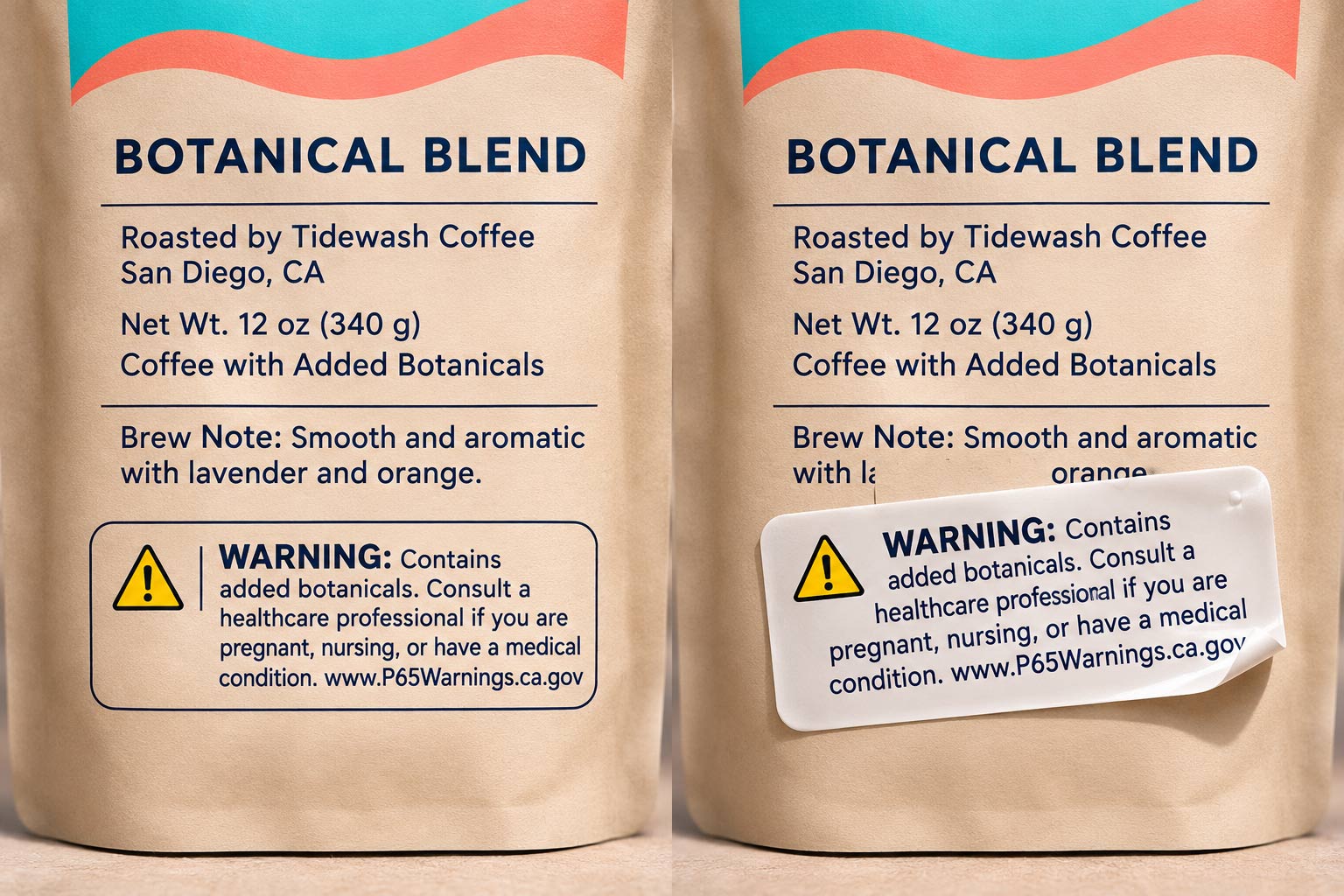
A Prop 65 warning is not a sticker you think about on shipping day. It is printed artwork, and it has to be "clear and reasonable." Most companies use California's "safe harbor" wording because following it is treated as compliant. A safe-harbor warning carries a signal word, a yellow triangle with an exclamation point, the name of at least one listed chemical, a short statement that it can cause cancer or reproductive harm, and a link to www.P65Warnings.ca.gov. The safe-harbor format is not mandatory, but it is the cleanest way to be sure your warning counts.
Two things matter once you decide to print one. It has to be legible, which on a small back panel means setting it the way you would any fine print, in a single solid ink at a readable size; our guide to
keeping small print sharp covers how. And it has to have a home in the layout. A warning block squeezed in at the last minute, or a label slapped over your finished artwork, looks exactly as bad as it sounds and can cover something else you were required to print. Give it a planned place on the back panel from the start.
Decide Before You Print
The worst time to discover you need a warning is after the bags are printed. The bag is a committed run, so changing the back panel means new artwork and a reprint, and a custom coffee bag takes about nine to twelve weeks from artwork approval. Make the call during design, not after delivery.
Two habits make this painless. If there is any chance you will add a flavoring or a functional ingredient later, leave a little clear space on the back-panel layout now, so a warning can go in without a redesign. And if you print
digital at 500 bags per design, you can revise and reprint a back panel without a huge commitment when your recipe or your compliance needs change. The same back panel also carries your net weight, roaster name and the rest of what the shelf requires; our
guide to what to write on a coffee bag covers the rest of that copy, and
the 2027 Kona blend labeling deadline is another case where a printed line has its own clock.
How Savor Brands Handles It
We are your packaging partner, not your lawyer, and the warning decision is yours to make with your own counsel. What we care about is that whatever you decide is printed correctly, legibly and in a planned place, and that you are never forced into a last-minute sticker.
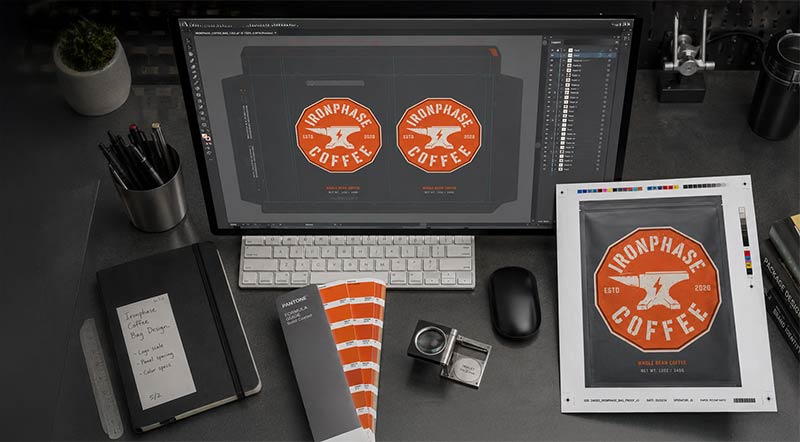
- We start with your dieline. Every custom bag begins with a dieline that shows each panel and fold, so if you decide a warning belongs on the back, there is a real place for it alongside your net weight and roaster information, not an afterthought.
- You approve a digital proof on the exact dieline before anything prints, so you can read the warning at size and confirm it, and every required line, is legible.
- We send samples first, so you can see the finished back panel in your hand before you order a full run.
- We tell you what is in the materials. If your question is about the bag itself rather than the coffee, ask us about the film, inks and closures; materials compliance is a fair question to put to any packaging supplier.
- We keep the minimum low. With digital printing from 500 bags per design, you can update a back panel as your recipe or your rules change, and if you want to start plain, a stock bag with a label is an easy way to test. Roasters shipping into the state can start from our California coffee packaging page.
Tell us where you sell and what is in your coffee, and we will make sure your
custom coffee bags carry exactly what you decide they should, printed so a shopper can actually read it.
Know Before You Print
Plain roasted coffee does not need a Prop 65 warning, because California decided in 2019 that the chemicals from roasting and brewing coffee pose no significant risk. The question only comes alive when you add an ingredient or when a material in the bag contains a listed chemical, so judge what you add and ask what your packaging is made of, rather than warning reflexively. If you conclude you need one, treat it as artwork: use the clear and reasonable safe-harbor format, set it legibly, and give it a planned place on the back panel before you print, because a reprint is a nine to twelve week clock. Decide on purpose, document the decision, and your bag says exactly what it should and nothing it should not. For the rest of what belongs on the panel, see our
preflight checklist for packaging artwork.