Why Do Dark Printed Boxes Get White Lines on the Edges?
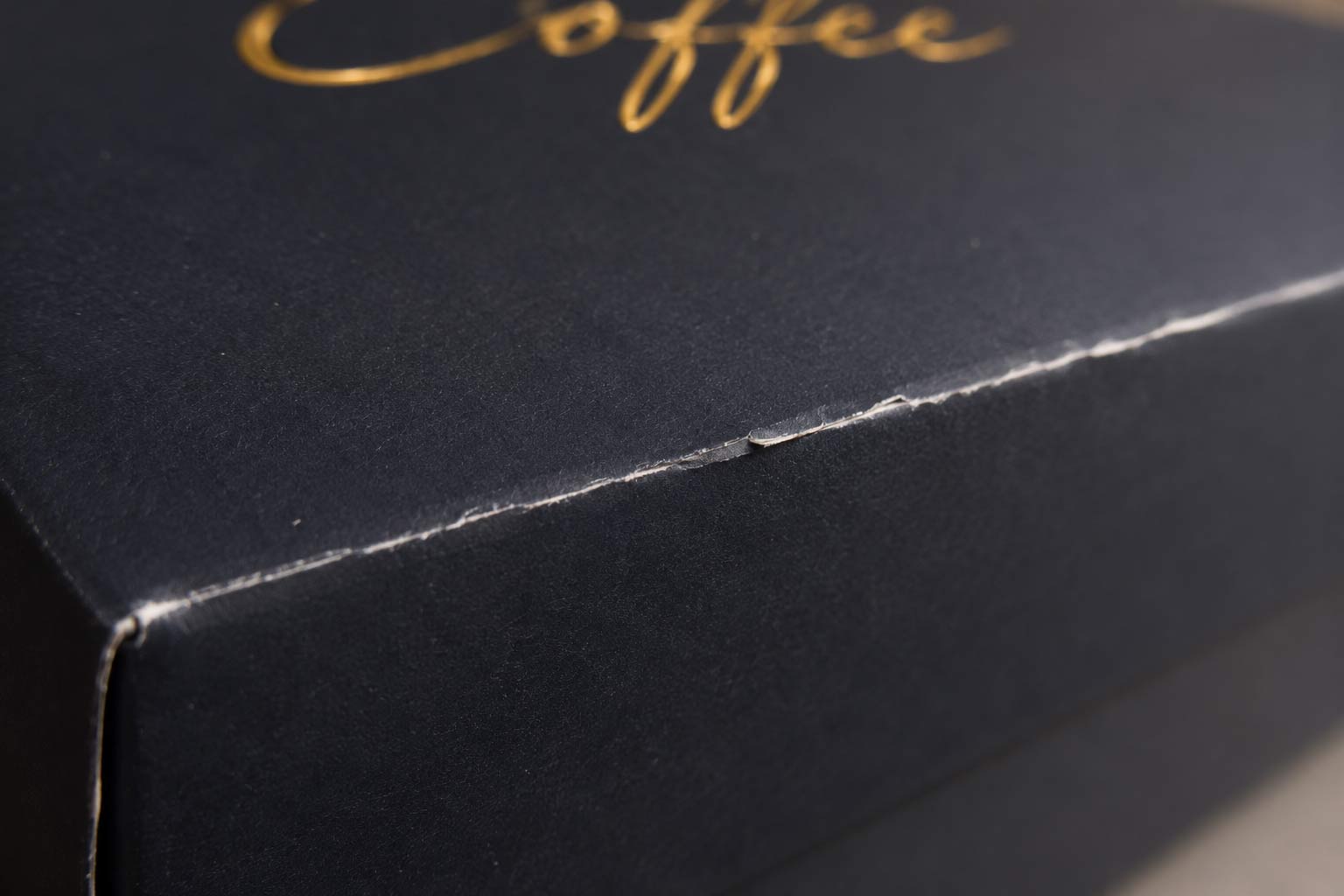
Because the box cracks a little every time it folds. A printed coffee box starts as a flat sheet of paperboard with a smooth coated surface on top, and that surface is where the ink and the finish sit. Before the box is folded, a crease is pressed into the board along every edge so it bends in the right place. When the board folds along that crease, the outside of the fold has to stretch to get around the corner.
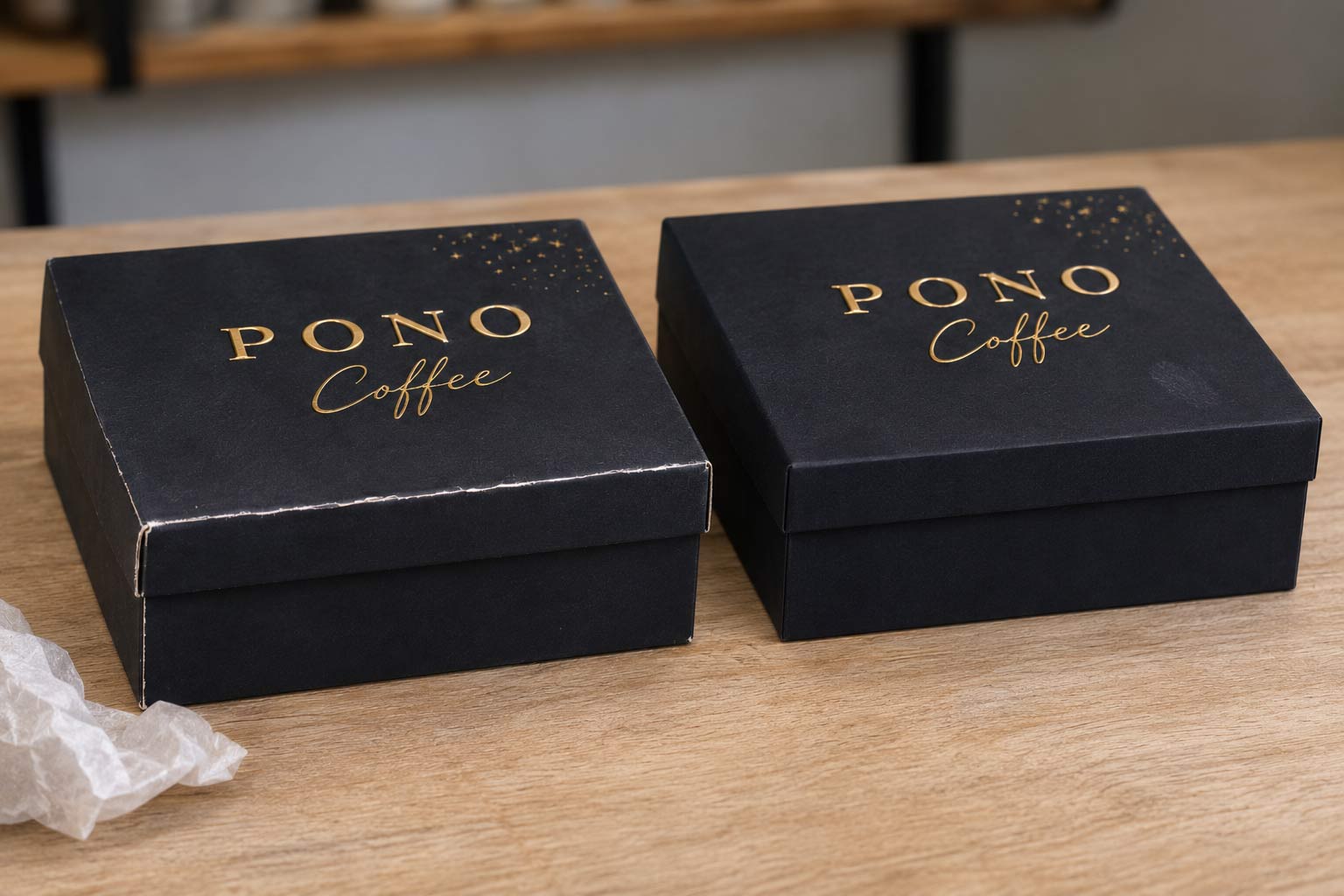
The paper fibers underneath can stretch a little. The coating, the ink and any varnish on top stretch much less. When the outside of the fold stretches further than that top layer can go, it splits along the crease and shows the plain board underneath. Our boxes start on white board, so on a black, navy or deep green box, that split reads as a thin white line running along every edge, every lid hinge and every corner.
A light colored box cracks too. You just cannot see it, because pale board under pale ink looks almost the same. That is why this problem seems to belong to dark boxes. The darker and more solid the color, the more every hairline crack shows.
If this sounds familiar, it is the same physics as our post on
why black coffee bags get white lines at the folds. A bag's film stretches at a hard fold and turns pale. A box's printed surface stretches at a crease and splits. Different material, same lesson: dark color and hard folds need to be planned together.
Was My Coffee Box Damaged in Shipping?
Probably not. White lines that run neatly along the folds, on every box in the carton, come from folding, not from a rough trip. Shipping damage looks different. It shows up as scuffs on flat panels, crushed corners, dents, and marks on the boxes that sat on the outside of the stack.
Here is a quick way to tell them apart:
- Folding cracks sit exactly on the crease lines, look the same on box after box, and often get worse the first time the box is opened and closed.
- Shipping damage is random. One box is crushed, the next is fine, and the marks land on flat areas and corners rather than along the folds.
- A flat, unfolded box from the same run shows no line at all until you fold it. Try it. If the line appears as you fold, the fold is the cause.
That last test matters, because it tells you where the fix lives. A fold crack is solved in the artwork, the board, the finish and the folding, not by asking the carrier to be more careful.
Why Is It Worse in Winter?
Because dry air makes paperboard brittle. Paper fibers hold a little moisture, and that moisture is part of what lets them bend without breaking. In the cold months, heated warehouses, offices and stockrooms pull moisture out of the air, and the board slowly gives up some of its own. Drier board cracks more easily at the crease.
This catches people out with holiday gift boxes in particular. The boxes arrive flat in the fall, sit in a heated back room for a few weeks, and then get folded up in a rush in December, right when the board is at its driest. A run that folded cleanly as a sample in summer can show white edges on the real thing in winter. Our guide to
planning winter coffee boxes and bags covers the rest of the season.
How Do You Stop Dark Boxes From Cracking at the Folds?
You cannot make a crease stretch-free, but you can make sure it does not show. Most of the fix happens before anything prints. Here is what works.
Plan the color around the folds. Look at the dieline, the flat drawing of your box, and find every fold: the lid hinge, the edges of the sides, the tuck flaps and the corners of a mailer. A solid dark color that runs straight across a fold is the setup for a white line. You can keep the dark look and still protect the folds. Let a pattern, a texture or a slightly lighter shade run along the edges, so a hairline crack disappears into it instead of standing out. Our
dieline guide explains how to read the drawing.
Keep important things off the folds. Your logo, your name and any fine lines or borders should sit on flat panels. A thin gold border that wraps right along an edge is the first thing to crack, and the first thing a customer notices.
Do not build the black too heavy. A dark area made by stacking several full layers of ink can be stiffer on the surface than a black printed with less ink. Ask your printer how they build a large dark area on your board, and keep the heaviest coverage away from the creases.
Ask about the finish. The finish on top of the print changes how the surface behaves at a fold. A laminated film finish, like many soft touch and gloss finishes, adds a thin flexible layer over the ink, and that layer can help hold the surface together at the crease. Coatings and varnishes behave differently. Finishes vary by printer and by board, so ask which of your options holds up best on a dark box, and see it on a folded sample.
Ask which way the board runs. Paperboard has a grain, the direction most of its fibers line up, and a fold behaves differently depending on whether it runs with the grain or across it. You do not need to manage this yourself. Just ask your printer whether the main folds on your design, like the lid hinge, are laid out to suit the grain of the board.
Store flat boxes away from dry heat. Keep cartons of flat boxes off heater vents, away from radiators and out of the hottest corner of the stockroom. If boxes have been sitting somewhere warm and dry, give them a day or two in a normal room before a big folding session.
Fold gently and once. Fold along the pressed crease in one smooth motion rather than forcing it flat with a hard press of the thumb, and avoid folding a box back and forth. Every extra bend opens the crack a little more.
Approve a folded sample, not just a flat proof. A flat proof cannot show you a fold crack, because there is no fold. Ask to see a sample box folded up on the real board with the real finish, then open and close the lid a few times. Our post on
mockups and proofs explains why a physical check catches what a screen cannot.
- Find every fold on the dieline before the design is final.
- Use a pattern or lighter shade along the edges instead of a solid dark flood.
- Keep logos, names and thin borders on flat panels.
- Ask how the dark areas are built and which finish holds up best.
- Ask whether the main folds suit the grain of the board.
- Store flat boxes away from heaters and fold them gently.
- Approve a folded sample on the real board and finish.
Do Rigid Boxes and Mailers Crack Too?
They can, in their own way. A rigid gift box is made from thick chipboard wrapped in a sheet of printed paper, and that wrap paper folds tightly around every edge and corner of the box. On a dark wrap, a corner where the paper was stretched too far can show a pale edge, just like a folding box.
Corrugated mailers have a printed outer layer over a fluted middle, and they crack along their creases for the same reasons, often more in dry winter air. If your coffee ships in a mailer, our post on
custom mailer boxes for coffee covers sizing and protection, and our post on
sizing custom coffee boxes around the filled bag helps you pick a box that fits without forcing the folds.
How Savor Brands Handles It
A dark box is a statement, and we want it to look as sharp on your customer's table as it does on the screen. That means thinking about the folds from the first drawing, not after the boxes arrive.
- We start with your product and your box style. Our custom printed boxes come in styles from 14, 18 and 24 pt cardstock to rigid and corrugated, and we confirm the board for your structure when we quote.
- We print on white board, so we will talk with you about where a dark design meets the folds before anything is printed.
- You choose the finish that fits the look: glossy, matte, soft touch, emboss or deboss, foil and spot UV, and we will help you weigh how each one suits a dark design.
- You approve a proof on the exact dieline, so you can see where every fold lands on your artwork.
- We start at 500 boxes per design, with about 9 to 12 weeks from artwork approval, so you can plan holiday boxes early enough to avoid a rushed, dry-season folding session.
Send us your design and tell us what goes inside, and we will help you build a dark box that keeps its edges clean.
Dark Box, Clean Edges
White lines on a dark printed coffee box are almost never shipping damage. They are small cracks where the printed surface splits as the board folds, and dark color makes every one of them show. Dry winter air makes it worse. The fix starts on the dieline: keep solid dark color, fine borders and logos off the folds, ask how the dark areas are built and which finish holds up best, store flat boxes away from heat, fold them gently, and approve a folded sample before the full run. Plan for the folds, and your dark box will look as good on the table as it did in the design.